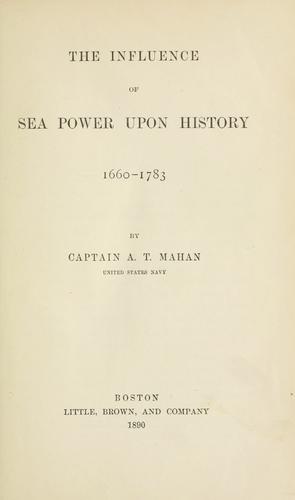
The Influence of Sea Power Upon History, 1660-1783Mahan, A. T. (Alfred Thayer)
History
The Influence of Sea Power Upon History, 1660-1783
Mahan, A. T. (Alfred Thayer)
Naval history, Modern; Sea-power
In the midst of the confused _mêlées_ of 1652 the fire-ship "acted, so
to speak, alone, seeking by chance an enemy to grapple, running the
risk of a mistake, without protection against the guns of the enemy,
nearly sure to be sunk by him or else burned uselessly. All now, in
1665, has become different. Its prey is clearly pointed out; it knows
it, follows it easily into the relatively fixed position had by it in
the enemy's line. On the other hand, the ships of his own division do
not lose sight of the fire-ship. They accompany it as far as possible,
cover it with their artillery to the end of its course, and disengage
it before burning, if the fruitlessness of the attempt is seen soon
enough. Evidently under such conditions its action, always uncertain
(it cannot be otherwise), nevertheless acquires greater chances of
success." These instructive comments need perhaps the qualifying, or
additional, remark that confusion in the enemy's order at the time
that your own remains good gives the best opening for a desperate
attack. The writer goes on to trace the disappearance of the
fire-ship:--
"Here then we see the fire-ship at the point of its highest
importance. That importance will decrease, the fire-ship itself
will end by disappearing from engagements in _the open sea_,
when naval artillery becoming more perfect shall have greater
range, be more accurate and more rapid;[23] when ships receiving
better forms, greater steering power, more extensive and better
balanced sail power, shall be able, thanks to quicker speed and
handling, to avoid almost certainly the fire-ships sent against
them; when, finally, fleets led on principles of tactics as
skilful as they were timid, a tactics which will predominate a
century later during the whole war of American Independence,
when these fleets, in order not to jeopardize the perfect
regularity of their order of battle, will avoid coming to close
quarters, and will leave to the cannon alone to decide the fate
of an action."
Public-domain text, read in full here on John Shaqi.
Reviews
Reviews
No reviews yet
Be the first to share your thoughts on this work.
Elsewhere in the archive
Join the Discussion
Join the discussion
Sign in to leave a comment or review.
Sign InorCreate an account