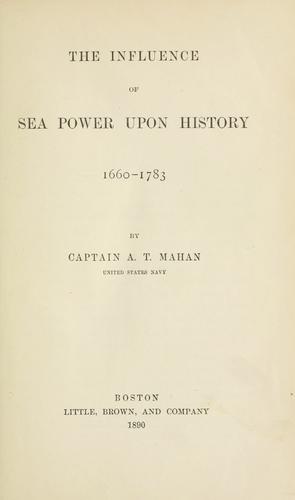
The Influence of Sea Power Upon History, 1660-1783Mahan, A. T. (Alfred Thayer)
History
The Influence of Sea Power Upon History, 1660-1783
Mahan, A. T. (Alfred Thayer)
Naval history, Modern; Sea-power
"With the increase of power of the ship-of-war, and with the
perfecting of its sea and warlike qualities, there has come an
equal progress in the art of utilizing them.... As naval
evolutions become more skilful, their importance grows from day
to day. To these evolutions there is needed a base, a point from
which they depart and to which they return. A fleet of war-ships
must be always ready to meet an enemy; logically, therefore,
this point of departure for naval evolutions must be the order
of battle. Now, since the disappearance of galleys, almost all
the artillery is found upon the sides of a ship of war. Hence
it is the beam that must necessarily and always be turned toward
the enemy. On the other hand, it is necessary that the sight of
the latter must never be interrupted by a friendly ship. Only
one formation allows the ships of the same fleet to satisfy
fully these conditions. That formation is the line ahead
[column]. This line, therefore, is imposed as the only order of
battle, and consequently as the basis of all fleet tactics. In
order that this order of battle, this long thin line of guns,
may not be injured or broken at some point weaker than the rest,
there is at the same time felt the necessity of putting in it
only ships which, if not of equal force, have at least equally
strong sides. Logically it follows, at the same moment in which
the line ahead became definitively the order for battle, there
was established the distinction between the ships 'of the line,'
alone destined for a place therein, and the lighter ships meant
for other uses."
Public-domain text, read in full here on John Shaqi.
Reviews
Reviews
No reviews yet
Be the first to share your thoughts on this work.
Elsewhere in the archive
Join the Discussion
Join the discussion
Sign in to leave a comment or review.
Sign InorCreate an account