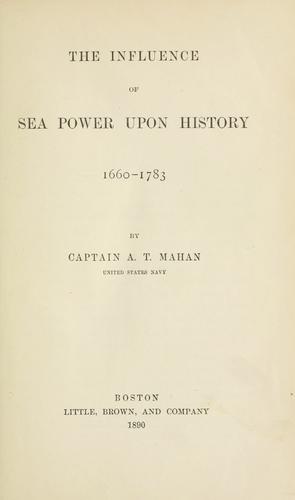
The Influence of Sea Power Upon History, 1660-1783Mahan, A. T. (Alfred Thayer)
History
The Influence of Sea Power Upon History, 1660-1783
Mahan, A. T. (Alfred Thayer)
Naval history, Modern; Sea-power
Macaulay says of this period: "During many months of 1693 the English
trade with the Mediterranean had been interrupted almost entirely.
There was no chance that a merchantman from London or Amsterdam would,
if unprotected, reach the Pillars of Hercules without being boarded by
a French privateer; and the protection of armed vessels was not easily
obtained." Why? Because the vessels of England's navy were occupied
watching the French navy, and this diversion of them from the cruisers
and privateers constituted the support which a commerce-destroying war
must have. A French historian, speaking of the same period in England
(1696), says: "The state of the finances was deplorable; money was
scarce, maritime insurance thirty per cent, the Navigation Act was
virtually suspended, and the English shipping reduced to the necessity
of sailing under the Swedish and Danish flags."[41] Half a century
later the French government was again reduced, by long neglect of the
navy, to a cruising warfare. With what results? First, the French
historian says: "From June, 1756, to June, 1760, French privateers
captured from the English more than twenty-five hundred merchantmen.
In 1761, though France had not, so to speak, a single ship-of-the-line
at sea, and though the English had taken two hundred and forty of our
privateers, their comrades still took eight hundred and twelve
vessels. But," he goes on to say, "the prodigious growth of the
English shipping explains the number of these prizes."[42] In other
words, the suffering involved to England in such numerous captures,
which must have caused great individual injury and discontent, did not
really prevent the growing prosperity of the State and of the
community at large. The English naval historian, speaking of the same
period, says: "While the commerce of France was nearly destroyed, the
trading-fleet of England covered the seas. Every year her commerce was
increasing; the money which the war carried out was returned by the
produce of her industry. Eight thousand merchant vessels were employed
by the English merchants." And again, summing up the results of the
war, after stating the immense amount of specie brought into the
kingdom by foreign conquests, he says: "The trade of England increased
gradually every year, and such a scene of national prosperity, while
waging a long, bloody, and costly war, was never before shown by any
people in the world." On the other hand, the historian of the French
navy, speaking of an earlier phase of the same wars, says: "The
English fleets, having nothing to resist them, swept the seas. Our
privateers and single cruisers, having no fleet to keep down the
abundance of their enemies, ran short careers. Twenty thousand French
seamen lay in English prisons."[43] When, on the other hand, in the
War of the American Revolution France resumed the policy of Colbert
and of the early reign of Louis XIV., and kept large battle-fleets
Public-domain text, read in full here on John Shaqi.
Reviews
Reviews
No reviews yet
Be the first to share your thoughts on this work.
Elsewhere in the archive
Join the Discussion
Join the discussion
Sign in to leave a comment or review.
Sign InorCreate an account