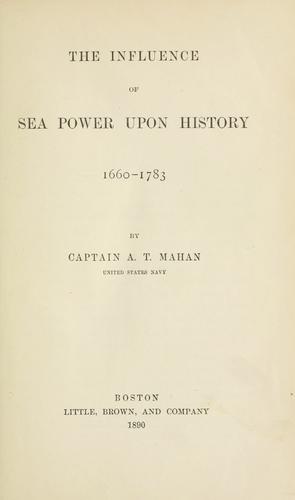
The Influence of Sea Power Upon History, 1660-1783Mahan, A. T. (Alfred Thayer)
History
The Influence of Sea Power Upon History, 1660-1783
Mahan, A. T. (Alfred Thayer)
Naval history, Modern; Sea-power
The English and French put to sea about the 1st of June, under the
command of Prince Rupert, first cousin to the king, the Duke of York
having been obliged to resign his office on account of the passage of
the Test Act, directed against persons of the Roman Catholic faith
holding any public employment. The French were under Vice-Admiral
d'Estrées, the same who had commanded them at Solebay. A force of six
thousand English troops at Yarmouth was ready to embark if De Ruyter
was worsted. On the 7th of June the Dutch were made out, riding within
the sands at Schoneveldt. A detached squadron was sent to draw them
out, but Ruyter needed no invitation; the wind served, and he followed
the detached squadron with such impetuosity as to attack before the
allied line was fairly formed. On this occasion the French occupied
the centre. The affair was indecisive, if a battle can be called so in
which an inferior force attacks a superior, inflicts an equal loss,
and frustrates the main object of the enemy. A week later Ruyter again
attacked, with results which, though indecisive as before as to the
particular action, forced the allied fleet to return to the English
coast to refit, and for supplies. The Dutch in these encounters had
fifty-five ships-of-the-line; their enemies eighty-one, fifty-four of
which were English.
The allied fleets did not go to sea again until the latter part of
July, and this time they carried with them a body of troops meant for
a landing. On the 20th of August the Dutch fleet was seen under way
between the Texel and the Meuse. Rupert at once got ready to fight;
but as the wind was from the northward and westward, giving the allies
the weather-gage, and with it the choice of the method of attack,
Ruyter availed himself of his local knowledge, keeping so close to the
beach that the enemy dared not approach,--the more so as it was late
in the day. During the night the wind shifted to east-southeast off
the land, and at daybreak, to use the words of a French official
narrative, the Dutch "made all sail and stood down boldly into
action."
Public-domain text, read in full here on John Shaqi.
Reviews
Reviews
No reviews yet
Be the first to share your thoughts on this work.
Elsewhere in the archive
Join the Discussion
Join the discussion
Sign in to leave a comment or review.
Sign InorCreate an account