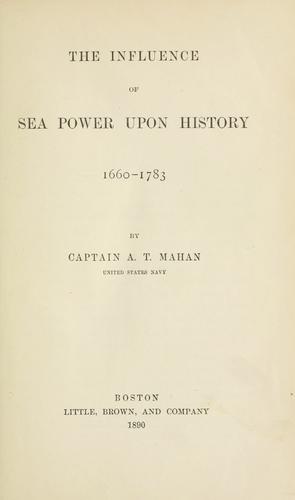
The Influence of Sea Power Upon History, 1660-1783Mahan, A. T. (Alfred Thayer)
History
The Influence of Sea Power Upon History, 1660-1783
Mahan, A. T. (Alfred Thayer)
Naval history, Modern; Sea-power
France stood alone against many enemies; but those enemies
were raised and kept moving by English subsidies. The Lord Treasurer
of England, writing in 1706 to Marlborough, says:--
"Though the land and trade of both England and Holland have
excessive burthens upon them, yet the credit continues good both
of them and us; whereas the finances of France are so much more
exhausted that they are forced to give twenty and twenty-five
per cent for every penny they send out of the kingdom, unless
they send it in specie."
In 1712 the expenditure of France was 240,000,000 francs, while the
taxes brought in only 113,000,000 gross, of which, after deducting
losses and necessary expenses, only 37,000,000 remained in the
treasury; the deficit was sought to be met by anticipating parts of
the revenue for years ahead, and by a series of extraordinary
transactions tedious to name or to understand.
"In the summer of 1715 [two years after the peace] it seemed as
if the situation could not grow worse,--no more public nor
private credit; no more clear revenue for the State; the
portions of the revenue not pledged, anticipated on the
following years. Neither labor nor consumption could be resumed
for want of circulation; usury reigned on the ruins of society.
The alternations of high prices and the depreciation of
commodities finally crushed the people. Provision riots broke
out among them, and even in the army. Manufactures were
languishing or suspended; forced mendicity was preying upon the
cities. The fields were deserted, the lands fallow for lack of
instruments, for lack of manure, for lack of cattle; the houses
were falling to ruin. Monarchical France seemed ready to expire
with its aged king."[78]
Thus it was in France, with a population of nineteen millions at that
time to the eight millions of all the British Islands; with a land
vastly more fertile and productive; before the great days, too, of
coal and iron. "In England, on the contrary, the immense grants of
Parliament in 1710 struck the French prodigiously; for while their
credit was low, or in a manner quite gone, ours was at its zenith."
During that same war "there appeared that mighty spirit among our
merchants which enabled them to carry on all their schemes with a
vigor that kept a constant circulation of money throughout the
kingdom, and afforded such mighty encouragement to all manufactures as
has made the remembrance of those times grateful in worse."
Public-domain text, read in full here on John Shaqi.
Reviews
Reviews
No reviews yet
Be the first to share your thoughts on this work.
Elsewhere in the archive
Join the Discussion
Join the discussion
Sign in to leave a comment or review.
Sign InorCreate an account