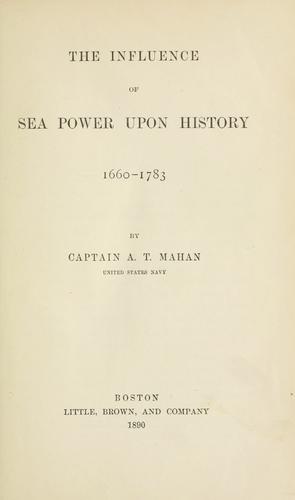
The Influence of Sea Power Upon History, 1660-1783Mahan, A. T. (Alfred Thayer)
History
The Influence of Sea Power Upon History, 1660-1783
Mahan, A. T. (Alfred Thayer)
Naval history, Modern; Sea-power
in the condition of the rival nations in India everything depended
upon controlling the sea.
Such were the relative situations of the three countries in the
principal foreign theatres of war. No mention has been made of the
colonies on the west coast of Africa, because they were mere trading
stations having no military importance. The Cape of Good Hope was in
possession of the Dutch, who took no active part in the earlier wars,
but long maintained toward England a benevolent neutrality, surviving
from the alliance in the former wars of the century. It is necessary
to mention briefly the condition of the military navies, which were
to have an importance as yet unrealized. Neither precise numbers nor
an exact account of condition of the ships can be given; but the
relative efficiency can be fairly estimated. Campbell, the English
contemporary naval historian, says that in 1727 the English navy had
eighty-four ships-of-the-line, from sixty guns up; forty 50-gun ships,
and fifty-four frigates and smaller vessels. In 1734 this number had
fallen to seventy ships-of-the-line and nineteen 50-gun ships. In
1744, after four years of war with Spain alone, the number was ninety
ships-of-the-line and eighty-four frigates. The French navy at the
same time he estimates at forty-five ships-of-the-line and sixty-seven
frigates. In 1747, near the end of the first war, he says that the
royal navy of Spain was reduced to twenty-two ships-of-the-line, that
of France to thirty-one, while the English had risen to one hundred
and twenty-six. The French writers consulted are less precise in their
figures, but agree in representing not only that the navy was reduced
to a pitiful number of ships, but that these were in bad condition and
the dock-yards destitute of materials. This neglect of the navy lasted
more or less throughout these wars, until 1760, when the sense of the
nation was aroused to the importance of restoring it; too late,
however, to prevent the most serious of the French losses. In England
as well as in France discipline and administration had been sapped by
the long peace; the inefficiency of the armaments sent out was
notorious, and recalls the scandals that marked the outbreak of the
Crimean War; while the very disappearance of the French ships led, by
the necessity of replacing them, to putting afloat vessels superior
singly, because more modern and scientific, to the older ships of the
same class in England. Care must be had, however, in accepting too
easily the complaints of individual writers; French authors will be
found asserting that English ships are faster, while at the same
period Englishmen complain that they are slower. It may be accepted as
generally true that the French ships built between 1740 and 1800 were
better designed and larger, class for class, than the English. The
latter had the undoubted superiority both in the number and quality
of the seamen and officers. Keeping some fleets always afloat, whether
Public-domain text, read in full here on John Shaqi.
Reviews
Reviews
No reviews yet
Be the first to share your thoughts on this work.
Elsewhere in the archive
Join the Discussion
Join the discussion
Sign in to leave a comment or review.
Sign InorCreate an account