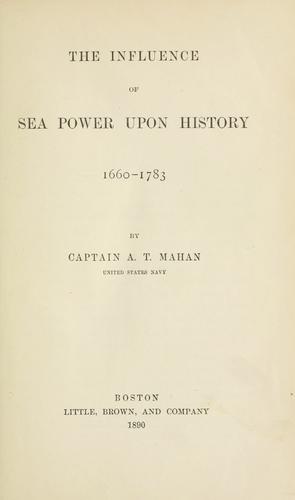
The Influence of Sea Power Upon History, 1660-1783Mahan, A. T. (Alfred Thayer)
History
The Influence of Sea Power Upon History, 1660-1783
Mahan, A. T. (Alfred Thayer)
Naval history, Modern; Sea-power
War having been declared against Spain by England in October, 1739,
the first attempts of the latter power were naturally directed against
the Spanish-American colonies, the cause of the dispute, in which it
was expected to find an easy and rich prey. The first expedition
sailed under Admiral Vernon in November of the same year, and took
Porto Bello by a sudden and audacious stroke, but found only the
insignificant sum of ten thousand dollars in the port whence the
galleons sailed. Returning to Jamaica, Vernon received large
reinforcements of ships, and was joined by a land force of twelve
thousand troops. With this increased force, attempts were made upon
both Cartagena and Santiago de Cuba, in the years 1741 and 1742, but
in both wretched failures resulted; the admiral and the general
quarrelled, as was not uncommon in days when neither had an
intelligent comprehension of the other's business. Marryatt, when
characterizing such misunderstandings by a humorous exaggeration,
seems to have had in view this attempt on Cartagena: "The army thought
that the navy might have beaten down stone ramparts ten feet thick;
and the navy wondered why the army had not walked up the same
ramparts, which were thirty feet perpendicular."
Another expedition, justly celebrated for the endurance and
perseverance shown by its leader, and famous both for the hardships
borne and singular final success, was sent out in 1740 under Anson.
Its mission was to pass round Cape Horn and attack the Spanish
colonies on the west coast of South America. After many delays, due
apparently to bad administration, the squadron finally got away toward
the end of 1740. Passing the Cape at the worst season of the year, the
ships met a series of tempests of the most violent kind; the squadron
was scattered, never all to meet again, and Anson, after infinite
peril, succeeded in rallying a part of it at Juan Fernandez. Two ships
had put back to England, a third was lost to the southward of Chiloe.
With the three left to him he cruised along the South American coast,
taking some prizes and pillaging the town of Payta, intending to touch
near Panama and join hands with Vernon for the capture of that place
and the possession of the isthmus, if possible. Learning of the
disaster at Cartagena, he then determined to cross the Pacific and
waylay the two galleons that sailed yearly from Acapulco to Manila.
In the passage across, one of the two ships now left to him was found
in such bad condition that she had to be destroyed. With the other he
succeeded in his last undertaking, capturing the great galleon with a
million and a half dollars in specie. The expedition, from its many
misfortunes, had no military result beyond the terror and consequent
embarrassment caused to the Spanish settlements; but its very
misfortunes, and the calm persistency which worked out a great success
from them all, have given it a well-deserved renown.
Public-domain text, read in full here on John Shaqi.
Reviews
Reviews
No reviews yet
Be the first to share your thoughts on this work.
Elsewhere in the archive
Join the Discussion
Join the discussion
Sign in to leave a comment or review.
Sign InorCreate an account