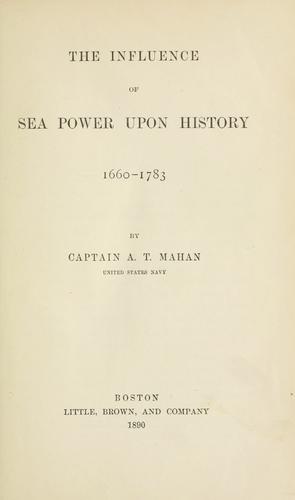
The Influence of Sea Power Upon History, 1660-1783Mahan, A. T. (Alfred Thayer)
History
The Influence of Sea Power Upon History, 1660-1783
Mahan, A. T. (Alfred Thayer)
Naval history, Modern; Sea-power
In North America, the declaration of peace was followed by renewed
agitation, which sprang from and betokened the deep feeling and keen
sense of the situation had by the colonists and local authorities on
either side. The Americans held to their points with the stubbornness
of their race. "There is no repose for our thirteen colonies," wrote
Franklin, "so long as the French are masters of Canada." The rival
claims to the central unsettled region, which may accurately enough be
called the valley of the Ohio, involved, if the English were
successful, the military separation of Canada from Louisiana; while on
the other hand, occupation by the French, linking the two extremes of
their acknowledged possessions, would shut up the English colonists
between the Alleghany Mountains and the sea. The issues were apparent
enough to leading Americans of that day, though they were more
far-reaching than the wisest of them could have foreseen; there is
room for curious speculation as to the effect, not only upon America,
but upon the whole world, if the French government had had the will,
and the French people the genius, effectively to settle and hold the
northern and western regions which they then claimed. But while
Frenchmen upon the spot saw clearly enough the coming contest and the
terrible disadvantage of unequal numbers and inferior navy under which
Canada must labor, the home government was blind alike to the value of
the colony and to the fact that it must be fought for; while the
character and habits of the French settlers, lacking in political
activity and unused to begin and carry through measures for the
protection of their own interests, did not remedy the neglect of the
mother-country. The paternal centralizing system of French rule had
taught the colonists to look to the mother-country, and then failed to
take care of them. The governors of Canada of that day acted as
careful and able military men, doing what they could to supply defects
and weaknesses; it is possible that their action was more consistent
and well-planned than that of the English governors; but with the
carelessness of both home governments, nothing in the end could take
the place of the capacity of the English colonists to look out for
themselves. It is odd and amusing to read the conflicting statements
of English and French historians as to the purposes and aims of the
opposing statesmen in these years when the first murmurings of the
storm were heard; the simple truth seems to be that one of those
conflicts familiarly known to us as irrepressible was at hand, and
that both governments would gladly have avoided it. The boundaries
might be undetermined; the English colonists were not.
Public-domain text, read in full here on John Shaqi.
Reviews
Reviews
No reviews yet
Be the first to share your thoughts on this work.
Elsewhere in the archive
Join the Discussion
Join the discussion
Sign in to leave a comment or review.
Sign InorCreate an account