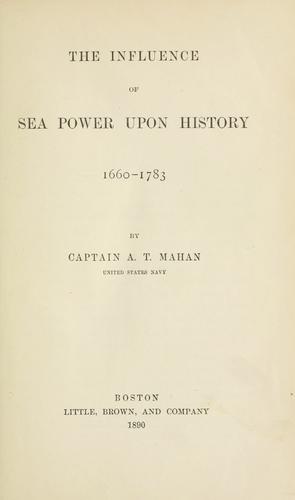
The Influence of Sea Power Upon History, 1660-1783Mahan, A. T. (Alfred Thayer)
History
The Influence of Sea Power Upon History, 1660-1783
Mahan, A. T. (Alfred Thayer)
Naval history, Modern; Sea-power
aloft was the loss of one topsail yard, whereas the English suffered
very badly. The true reason is probably that given and approved by one
of the French authorities on naval warfare. Galissonière considered
the support of the land attack on Mahon paramount to any destruction
of the English fleet, if he thereby exposed his own. "The French navy
has always preferred the glory of assuring or preserving a conquest to
that more brilliant perhaps, but actually less real, of taking some
ships, and therein has approached more nearly the true end that has
been proposed in war."[94] The justice of this conclusion depends upon
the view that is taken of the true end of naval war. If it is merely
to assure one or more positions ashore, the navy becomes simply a
branch of the army for a particular occasion, and subordinates its
action accordingly; but if the true end is to preponderate over the
enemy's navy and so control the sea, then the enemy's ships and fleets
are the true objects to be assailed on all occasions. A glimmer of
this view seems to have been present to Morogues when he wrote that at
sea there is no field of battle to be held, nor places to be won. If
naval warfare is a war of posts, then the action of the fleets must be
subordinate to the attack and defence of the posts; if its object is
to break up the enemy's power on the sea, cutting off his
communications with the rest of his possessions, drying up the sources
of his wealth in his commerce, and making possible a closure of his
ports, then the object of attack must be his organized military forces
afloat; in short, his navy. It is to the latter course, for whatever
reason adopted, that England owed a control of the sea that forced the
restitution of Minorca at the end of this war. It is to the former
that France owed the lack of prestige in her navy. Take this very case
of Minorca; had Galissonière been beaten, Richelieu and his fifteen
thousand troops must have been lost to France, cooped up in Minorca,
as the Spaniards, in 1718, were confined to Sicily. The French navy
therefore assured the capture of the island; but so slight was the
impression on the ministry and the public, that a French naval officer
tells us: "Incredible as it may seem, the minister of marine, after
the glorious affair off Mahon, instead of yielding to the zeal of an
enlightened patriotism and profiting by the impulse which this victory
gave to France to build up the navy, saw fit to sell the ships and
rigging which we still had in our ports. We shall soon see the
deplorable consequences of this cowardly conduct on the part of our
statesmen."[95] Neither the glory nor the victory is very apparent;
but it is quite conceivable that had the French admiral thought less
of Mahon and used the great advantage luck had given him to take, or
sink, four or five of the enemy, the French people would have
anticipated the outbreak of naval enthusiasm which appeared too late,
in 1760.
Public-domain text, read in full here on John Shaqi.
Reviews
Reviews
No reviews yet
Be the first to share your thoughts on this work.
Elsewhere in the archive
Join the Discussion
Join the discussion
Sign in to leave a comment or review.
Sign InorCreate an account