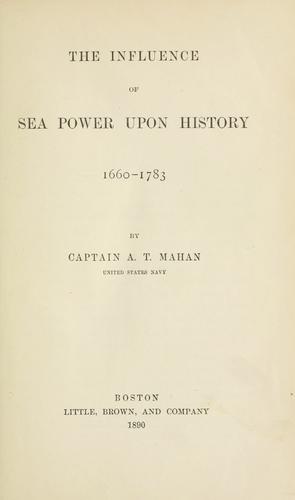
The Influence of Sea Power Upon History, 1660-1783Mahan, A. T. (Alfred Thayer)
History
The Influence of Sea Power Upon History, 1660-1783
Mahan, A. T. (Alfred Thayer)
Naval history, Modern; Sea-power
Such a formal utterance by an officer of rank must be received with
respect, and the more so when it expresses a consistent policy
followed by a great and warlike nation; yet it may be questioned
whether a sea power worthy of the name can thus be secured. Logically,
it follows from the position assumed, that combats between equal
forces are to be discouraged, because the loss to you is greater than
the loss to your opponent. "In fact," says Ramatuelle, upholding the
French policy, "of what consequence to the English would be the loss
of a few ships?" But the next inevitable step in the argument is that
it is better not to meet the enemy. As another Frenchman,[97]
previously quoted, says, it was considered a mishap to their ships to
fall in with a hostile force, and, if one was met, their duty was to
avoid action if possible to do so honorably. They had ulterior objects
of more importance than fighting the enemy's navy. Such a course
cannot be consistently followed for years without affecting the spirit
and tone of the officers charged with it; and it led directly to as
brave a man as ever commanded a fleet, the Comte de Grasse, failing to
crush the English under Rodney when he had the chance, in 1782. On the
9th of April of that year, being chased by the English among the
Windward Islands, it happened to him to have sixteen of their fleet
under his lee while the main body was becalmed under Dominica. Though
greatly superior to the separated ships, during the three hours that
this state of things lasted, De Grasse left them undisturbed, except
by a distant cannonade by his own van; and his action was justified by
the court which tried him, in which were many officers of high rank
and doubtless of distinction, as being "an act of prudence on the part
of the admiral, dictated to him by the ulterior projects of the
cruise." Three days later he was signally beaten by the fleet he had
failed to attack at disadvantage, and all the ulterior projects of the
cruise went down with him.
To return to Minorca; after the action of the 20th, Byng called a
council of war, which decided that nothing more could be done, and
that the English fleet should go to Gibraltar and cover that place
from an attack. At Gibraltar, Byng was relieved by Hawke and sent home
to be tried. The court-martial, while expressly clearing him of
cowardice or disaffection, found him guilty of not doing his utmost
either to defeat the French fleet or to relieve the garrison at
Mahon; and, as the article of war prescribed death with no
alternative punishment for this offence, it felt compelled to sentence
him to death. The king refused to pardon, and Byng was accordingly
shot.
The expedition against Minorca was begun while nominal peace still
lasted. On the 17th of May, three days before Byng's battle, England
declared war, and France replied on the 20th of June. On the 28th,
Port Mahon surrendered, and Minorca passed into the hands of France.
Public-domain text, read in full here on John Shaqi.
Reviews
Reviews
No reviews yet
Be the first to share your thoughts on this work.
Elsewhere in the archive
Join the Discussion
Join the discussion
Sign in to leave a comment or review.
Sign InorCreate an account