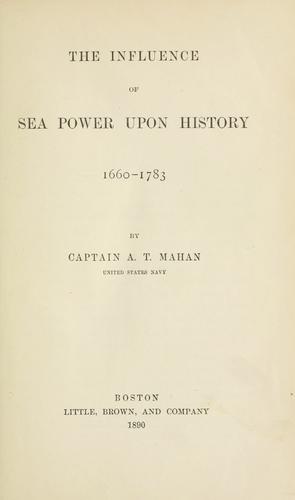
The Influence of Sea Power Upon History, 1660-1783Mahan, A. T. (Alfred Thayer)
History
The Influence of Sea Power Upon History, 1660-1783
Mahan, A. T. (Alfred Thayer)
Naval history, Modern; Sea-power
Instead of concentrating against England, France began another
continental war, this time with a new and extraordinary alliance. The
Empress of Austria, working on the religious superstitions of the king
and upon the anger of the king's mistress, who was piqued at sarcasms
uttered against her by Frederick the Great, drew France into an
alliance with Austria against Prussia. This alliance was further
joined by Russia, Sweden and Poland. The empress urged that the two
Roman Catholic powers should unite to take Silesia away from a
Protestant king, and expressed her willingness to give to France a
part of her possessions in the Netherlands, which France had always
desired.
Frederick the Great, learning the combination against him, instead of
waiting for it to develop, put his armies in motion and invaded
Saxony, whose ruler was also King of Poland. This movement, in
October, 1756, began the Seven Years' War; which, like the War of the
Austrian Succession, but not to the same extent, drew some of the
contestants off from the original cause of difference. But while
France, having already on hand one large quarrel with her neighbor
across the Channel, was thus needlessly entering upon another
struggle, with the avowed end of building up that Austrian empire
which a wiser policy had long striven to humble, England this time saw
clearly where her true interests lay. Making the continental war
wholly subsidiary, she turned her efforts upon the sea and the
colonies; at the same time supporting Frederick both with money and
cordial sympathy in the war for the defence of his kingdom, which so
seriously diverted and divided the efforts of France. England thus had
really but one war on hand. In the same year the direction of the
struggle was taken from the hands of a weak ministry and given into
those of the bold and ardent William Pitt, who retained his office
till 1761, by which time the ends of the war had practically been
secured.
Public-domain text, read in full here on John Shaqi.
Reviews
Reviews
No reviews yet
Be the first to share your thoughts on this work.
Elsewhere in the archive
Join the Discussion
Join the discussion
Sign in to leave a comment or review.
Sign InorCreate an account