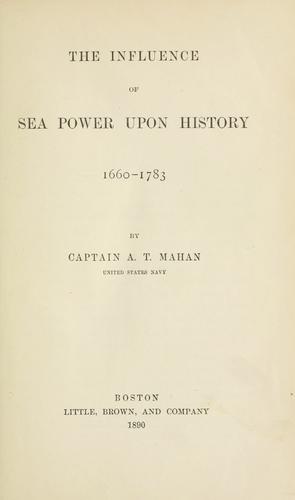
The Influence of Sea Power Upon History, 1660-1783Mahan, A. T. (Alfred Thayer)
History
The Influence of Sea Power Upon History, 1660-1783
Mahan, A. T. (Alfred Thayer)
Naval history, Modern; Sea-power
In the latter part of 1758, France, depressed by the sense of failure
upon the continent, mortified and harassed by English descents upon
her coasts, which had been particularly annoying that year, and seeing
that it was not possible to carry on both the continental and sea wars
with her money resources, determined to strike directly at England.
Her commerce was annihilated while the enemy's throve. It was the
boast of London merchants that under Pitt commerce was united with and
made to flourish by war;[98] and this thriving commerce was the soul
also of the land struggle, by the money it lavished on the enemy of
France.
At this time a new and active-minded minister, Choiseul, was called
into power by Louis XV. From the beginning of 1759, preparations were
made in the ocean and Channel ports. Flat-boats to transport troops
were built at Havre, Dunkirk, Brest, and Rochefort. It was intended to
embark as many as fifty thousand men for the invasion of England,
while twelve thousand were to be directed upon Scotland. Two squadrons
were fitted out, each of respectable strength, one at Toulon, the
other at Brest. The junction of these two squadrons at Brest was the
first step in the great enterprise.
It was just here that it broke down, through the possession of
Gibraltar by the English, and their naval superiority. It seems
incredible that even the stern and confident William Pitt should, as
late as 1757, have offered to surrender to Spain the watch-tower from
which England overlooks the road between the Mediterranean and the
Atlantic, as the price of her help to recover Minorca. Happily for
England, Spain refused. In 1759, Admiral Boscawen commanded the
English Mediterranean fleet. In making an attack upon French frigates
in Toulon roads, some of his ships were so damaged that he sailed with
his whole squadron to Gibraltar to refit; taking the precaution,
however, to station lookout frigates at intervals, and to arrange
signals by guns to notify him betimes of the enemy's approach. Taking
advantage of his absence, and in obedience to orders, the French
commodore, De la Clue, left Toulon with twelve ships-of-the-line on
the 5th of August, and on the 17th found himself at the Straits of
Gibraltar, with a brisk east wind carrying him out into the Atlantic.
Everything seemed propitious, a thick haze and falling night
concealing the French ships from the land, while not preventing their
sight of each other, when an English frigate loomed up in the near
distance. As soon as she saw the fleet, knowing they must be enemies,
she hauled in for the land and began firing signal-guns. Pursuit was
useless; flight alone remained. Hoping to elude the chase he knew must
follow, the French commodore steered west-northwest for the open sea,
putting out all lights; but either from carelessness or
disaffection,--for the latter is hinted by one French naval
officer,--five out of the twelve ships headed to the northward and put
Public-domain text, read in full here on John Shaqi.
Reviews
Reviews
No reviews yet
Be the first to share your thoughts on this work.
Elsewhere in the archive
Join the Discussion
Join the discussion
Sign in to leave a comment or review.
Sign InorCreate an account