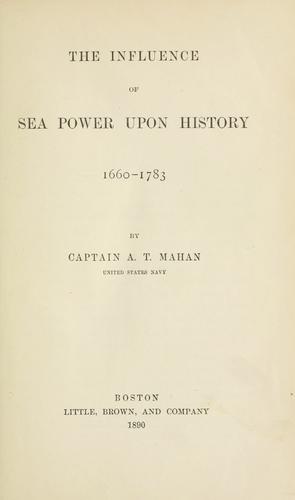
The Influence of Sea Power Upon History, 1660-1783Mahan, A. T. (Alfred Thayer)
History
The Influence of Sea Power Upon History, 1660-1783
Mahan, A. T. (Alfred Thayer)
Naval history, Modern; Sea-power
his squadron into Quiberon Bay, trusting and believing that Hawke
would not dare to follow, under the conditions of the weather, into a
bay which French authorities describe as containing banks and shoals,
and lined with reefs which the navigator rarely sees without fright
and never passes without emotion. It was in the midst of these ghastly
dangers that forty-four large ships were about to engage pell-mell;
for the space was too contracted for fleet manoeuvres. Conflans
flattered himself that he would get in first and be able to haul up
close under the western shore of the bay, forcing the enemy, if he
followed, to take position between him and the beach, six miles to
leeward. None of his expectations were fulfilled. In the retreat he
took the head of his fleet; a step not unjustifiable, since only by
leading in person could he have shown just what he wanted to do, but
unfortunate for his reputation with the public, as it placed the
admiral foremost in the flight. Hawke was not in the least, nor for
one moment, deterred by the dangers before him, whose full extent he,
as a skilful seaman, entirely realized; but his was a calm and
steadfast as well as a gallant temper, that weighed risks justly,
neither dissembling nor exaggerating. He has not left us his
reasoning, but he doubtless felt that the French, leading, would serve
partially as pilots, and must take the ground before him; he believed
the temper and experience of his officers, tried by the severe school
of the blockade, to be superior to those of the French; and he knew
that both the government and the country demanded that the enemy's
fleet should not reach another friendly port in safety. On the very
day that he was thus following the French, amid dangers and under
conditions that have made this one of the most dramatic of sea fights,
he was being burnt in effigy in England for allowing them to escape.
As Conflans, leading his fleet, was rounding the Cardinals,--as the
southernmost rocks at the entrance of Quiberon Bay are called,--the
leading English ships brought the French rear to action. It was
another case of a general chase ending in a _mêlée_, but under
conditions of exceptional interest and grandeur from the surrounding
circumstances of the gale of wind, the heavy sea, the lee shore, the
headlong speed, shortened canvas, and the great number of ships
engaged. One French seventy-four, closely pressed and outnumbered,
ventured to open her lower-deck ports; the sea sweeping in carried her
down with all on board but twenty men. Another was sunk by the fire of
Hawke's flag-ship. Two others, one of which carried a commodore's
pennant, struck their colors. The remainder were dispersed. Seven fled
to the northward and eastward, and anchored off the mouth of the
little river Vilaine, into which they succeeded in entering at the top
of high water in two tides,--a feat never before performed. Seven
others took refuge to the southward and eastward in Rochefort. One,
Public-domain text, read in full here on John Shaqi.
Reviews
Reviews
No reviews yet
Be the first to share your thoughts on this work.
Elsewhere in the archive
Join the Discussion
Join the discussion
Sign in to leave a comment or review.
Sign InorCreate an account