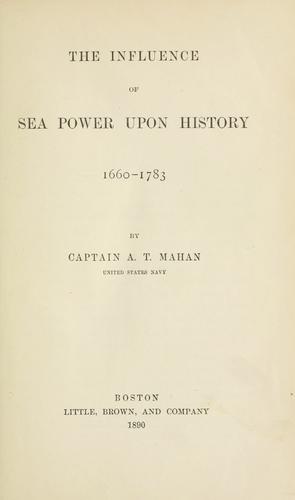
The Influence of Sea Power Upon History, 1660-1783Mahan, A. T. (Alfred Thayer)
History
The Influence of Sea Power Upon History, 1660-1783
Mahan, A. T. (Alfred Thayer)
Naval history, Modern; Sea-power
The nabob, who had not meant to allow this, took umbrage, and entered
into correspondence with Bussy in the Deccan. Clive had full knowledge
of his various intrigues, which were carried on with the vacillation
of a character as weak as it was treacherous; and seeing no hope of
settled peace or trade under the rule of this man, entered into an
extensive conspiracy for his dethronement, the details of which need
not be given. The result was that war broke out again, and that Clive
with three thousand men, one third of whom were English, met the nabob
at the head of fifteen thousand horse and thirty-five thousand foot.
The disproportion in artillery was nearly as great. Against these odds
was fought and won the battle of Plassey, on the 23d of June,
1757,--the date from which, by common consent, the British empire in
India is said to begin. The overthrow of the nabob was followed by
placing in power one of the conspirators against him, a creature of
the English, and dependent upon them for support. Bengal thus passed
under their control, the first-fruits of India. "Clive," says a French
historian, "had understood and applied the system of Dupleix."
This was true; yet even so it may be said that the foundation thus
laid could never have been kept nor built upon, had the English nation
not controlled the sea. The conditions of India were such that a few
Europeans, headed by men of nerve and shrewdness, dividing that they
might conquer, and advancing their fortunes by judicious alliances,
were able to hold their own, and more too, amidst overwhelming
numerical odds; but it was necessary that they should not be opposed
by men of their own kind, a few of whom could turn the wavering
balance the other way. At the very time that Clive was acting in
Bengal, Bussy invaded Orissa, seized the English factories, and made
himself master of much of the coast regions between Madras and
Calcutta; while a French squadron of nine ships, most of which,
however, belonged to the East India Company and were not first-rate
men-of-war, was on its way to Pondicherry with twelve hundred regular
troops,--an enormous European army for Indian operations of that day.
The English naval force on the coast, though fewer in numbers, may be
considered about equal to the approaching French squadron. It is
scarcely too much to say that the future of India was still uncertain,
and the first operations showed it.
Public-domain text, read in full here on John Shaqi.
Reviews
Reviews
No reviews yet
Be the first to share your thoughts on this work.
Elsewhere in the archive
Join the Discussion
Join the discussion
Sign in to leave a comment or review.
Sign InorCreate an account