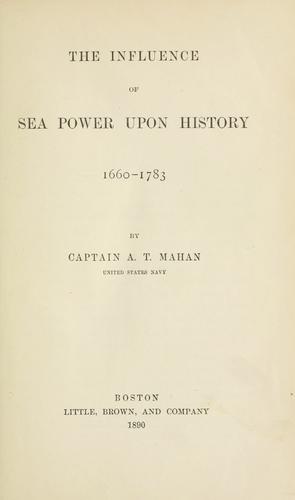
The Influence of Sea Power Upon History, 1660-1783Mahan, A. T. (Alfred Thayer)
History
The Influence of Sea Power Upon History, 1660-1783
Mahan, A. T. (Alfred Thayer)
Naval history, Modern; Sea-power
Upon arriving at the islands, D'Aché found a state of things which
again singularly illustrates the impotence and short-sightedness
characteristic of the general naval policy of the French at this time.
His arrival there was as unwelcome as his departure from India had
been to Lally. The islands were then in a state of the most complete
destitution. The naval division, increased by the arrival of three
ships-of-the-line from home, so exhausted them that its immediate
departure was requested of the commodore. Repairs were pushed ahead
rapidly, and in November several of the ships sailed to the Cape of
Good Hope, then a Dutch colony, to seek provisions; but these were
consumed soon after being received, and the pressure for the departure
of the squadron was renewed. The situation of the ships was no less
precarious than that of the colony; and accordingly the commodore
replied by urging his entire lack of food and supplies. The condition
was such that, a little later, it was necessary to make running
rigging out of the cables, and to put some of the ships on the bottom,
so as to give their materials to others. Before returning to India,
D'Aché wrote to the minister of the navy that he "was about to leave,
only to save the crews from dying of hunger, and that nothing need be
expected from the squadron if supplies were not sent, for both men and
things were in a deplorable state."
Under these circumstances D'Aché sailed from the islands in July,
1759, and arrived off the Coromandel coast in September. During his
year of absence Lally had besieged Madras for two months, during the
northeast monsoon. Both squadrons were absent, that season being unfit
for naval operations on this coast; but the English returned first,
and are said by the French to have caused, by the English to have
hastened, the raising of the siege. D'Aché, upon his return, was much
superior in both number and size of ships; but when the fleets met,
Pocock did not hesitate to attack with nine against eleven. This
action, fought September 10, 1759, was as indecisive as the two
former; but D'Aché retreated, after a very bloody contest. Upon it
Campbell, in his "Lives of the Admirals," makes a droll, but seemingly
serious, comment: "Pocock had reduced the French ships to a very
shattered condition, and killed a great many of their men; but what
shows the singular talents of both admirals, they had fought three
pitched battles in eighteen months without the loss of a ship on
either side." The fruits of victory, however, were with the weaker
fleet; for D'Aché returned to Pondicherry and thence sailed on the 1st
of the next month for the islands, leaving India to its fate. From
that time the result was certain. The English continued to receive
reinforcements from home, while the French did not; the men opposed to
Lally were superior in ability; place after place fell, and in
January, 1761, Pondicherry itself surrendered, surrounded by land and
cut off from the sea.
Public-domain text, read in full here on John Shaqi.
Reviews
Reviews
No reviews yet
Be the first to share your thoughts on this work.
Elsewhere in the archive
Join the Discussion
Join the discussion
Sign in to leave a comment or review.
Sign InorCreate an account