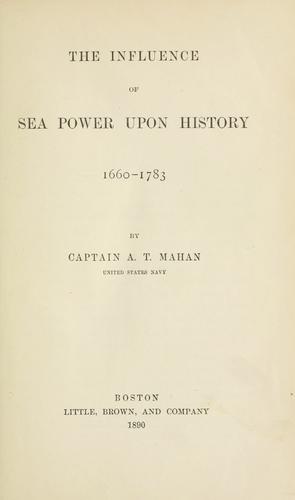
The Influence of Sea Power Upon History, 1660-1783Mahan, A. T. (Alfred Thayer)
History
The Influence of Sea Power Upon History, 1660-1783
Mahan, A. T. (Alfred Thayer)
Naval history, Modern; Sea-power
[8] An interesting proof of the weight attributed to the naval power
of Great Britain by a great military authority will be found in the
opening chapter of Jomini's "History of the Wars of the French
Revolution." He lays down, as a fundamental principle of European
policy, that an unlimited expansion of naval force should not be
permitted to any nation which cannot be approached by land,--a
description which can apply only to Great Britain.
[9] Gougeard: La Marine de Guerre; Richelieu et Colbert.
[10] Whatever may be thought of Clerk's claim to originality in
constructing a system of naval tactics, and it has been seriously
impugned, there can be no doubt that his criticisms on the past were
sound. So far as the author knows, he in this respect deserves credit
for an originality remarkable in one who had the training neither of a
seaman nor of a military man.
[11] La Serre: Essais Hist. et Crit. sur la Marine Française.
[12] Lapeyrouse-Bonfils: Hist. de la Marine Française.
[13] Jurien de la Gravière: Guerres Maritimes.
[14] Since the above was written, the secretary of the navy, in his
report for 1889, has recommended a fleet which would make such a
blockade as here suggested very hazardous.
[15] The word "defence" in war involves two ideas, which for the sake
of precision in thought should be kept separated in the mind. There is
defence pure and simple, which strengthens itself and awaits attack.
This may be called passive defence. On the other hand, there is a view
of defence which asserts that safety for one's self, the real object
of defensive preparation, is best secured by attacking the enemy. In
the matter of sea-coast defence, the former method is exemplified by
stationary fortifications, submarine mines, and generally all immobile
works destined simply to stop an enemy if he tries to enter. The
second method comprises all those means and weapons which do not wait
for attack, but go to meet the enemy's fleet, whether it be but for a
few miles, or whether to his own shores. Such a defence may seem to be
really offensive war, but it is not; it becomes offensive only when
its object of attack is changed from the enemy's fleet to the enemy's
country. England defended her own coasts and colonies by stationing
her fleets off the French ports, to fight the French fleet if it came
out. The United States in the Civil War stationed her fleets off the
Southern ports, not because she feared for her own, but to break down
the Confederacy by isolation from the rest of the world, and
ultimately by attacking the ports. The methods were the same; but the
purpose in one case was defensive, in the other offensive.
Public-domain text, read in full here on John Shaqi.
Reviews
Reviews
No reviews yet
Be the first to share your thoughts on this work.
Elsewhere in the archive
Join the Discussion
Join the discussion
Sign in to leave a comment or review.
Sign InorCreate an account