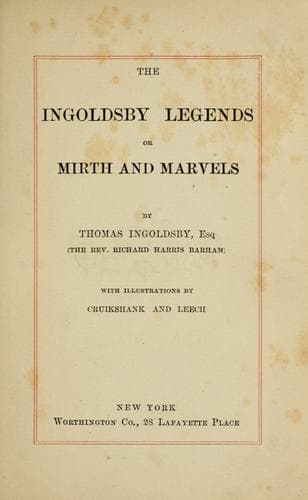
The Ingoldsby Legends; or, Mirth and MarvelsIngoldsby, Thomas
General
The Ingoldsby Legends; or, Mirth and Marvels
Ingoldsby, Thomas
English fiction -- 19th century; English poetry -- 19th century; English wit and humor; Humorous poetry, English
_3tio._
Look well to your Maid-servants!--say you expect them
To see to the children, and not to neglect them!--
And if you're a widower, just throw a cursory
Glance in, at times, when you go near the Nursery!--
--Perhaps it's as well to keep children from plums,
And from pears in the season,--and sucking their thumbs!
_4to._
To sum up the whole with a "Saw" of much use,
Be _just_, and be _generous_--don't be _profuse_!--
Pay the debts that you owe,--keep your word to your friends,
But--DON'T SET YOUR CANDLES ALIGHT AT BOTH ENDS!!--
For of this be assured, if you "go it" too fast,
You'll be "dish'd" like Sir Guy,
And like him, perhaps, die
A poor, old, half-starved Country Parson at last!
[Illustration: seal]
From a seal attached to an ancient deed _penes_ =Thomas
Ingoldsby=, Esq., preserved in the archives at Tappington Everard.
FOOTNOTES:
[47] For a full account of this facetious "_Chivaler_," see
the late (oh! that we should have to say "late"!) Theodore Hook's
"History of the illustrious Commoners of Great Britain," as quoted in
the Memoirs of John Bragg, Esq., page 344 of the 75th volume of the
Standard Novels. In the third volume of Sir Harris Nicolas's elaborate
account of the Scrope and Grosvenor controversy, commonly called the
"Scrope Roll," a Stephen de Hoques, Ecuyer, is described as giving his
testimony on the Grosvenor side.--_Vide_ page 247.
[48] A peruke so named from its inventor. Robert de Ros and
Eudo Fitz-Vicari were celebrated _perruquiers_, who flourished in the
eleventh century. The latter is noticed in the Battle-Abbey roll, and
is said to have curled William the Conqueror's hair when dressing for
the battle of Hastings. Dugdale makes no mention of him, but Camden
says, that Humfrey, one of his descendants, was summoned to Parliament,
26 Jan. 25 Edw. I. (1297). It is doubtful, however, whether that writ
can be deemed a regular writ of summons to Parliament, for reasons
amply detailed in the "Synopsis of the British Peerage."--(Art.
Fitz-John.) A writ was subsequently addressed to him as "_Humfry
Fitz-Vicari, Chiv^{r.}_" 8 Jan. 6 Edw. II. (1313), and his descendants
appear to have been regularly summoned as late as 5 and 6 of Philip and
Mary, 1557-8. Soon after which Peter Fitz-Vicari dying, S. P. M. this
Barony went into abeyance between his two daughters, Joan, married to
Henry de Truefit, of Fullbottom, and Alice, wife of Roger Wigram, of
Caxon Hall, in Wigton, co. Cumb. Esq., among whose representatives it
is presumed to be still in abeyance.
[49] _Vide_ Dugdale's Monasticon, Art. _Prioratus de Bolton,
in agro Eboracensi_.
Public-domain text, read in full here on John Shaqi.
Reviews
Reviews
No reviews yet
Be the first to share your thoughts on this work.
Elsewhere in the archive
Join the Discussion
Join the discussion
Sign in to leave a comment or review.
Sign InorCreate an account