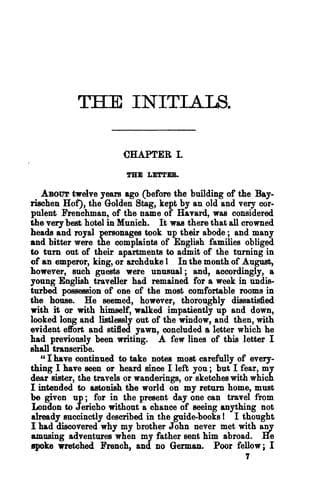
The Initials: A Story of Modern LifeTautphoeus, Jemima Montgomery, Baroness
General
The Initials: A Story of Modern Life
Tautphoeus, Jemima Montgomery, Baroness
Bavaria (Germany) -- Fiction; British -- Germany -- Fiction; Love stories
“But the ring was still on my finger, and perhaps she thought——”
“What?” asked Hamilton, laughing, as he followed Hildegarde, and
obtained the piece of cake which he requested. Madame Lustig, who did
not perceive his vicinity, observed to Dr. Berger, “Your wife is getting
on at a great rate with that young Englishman to-night.”
“It’s a way she has,” he replied, shrugging his shoulders, “opposition
only makes her worse, so I generally pretend not to see her. At all
events, I have discovered long ago that the Englishman’s heart and
thoughts are elsewhere, even when he is apparently completely engrossed
in my Lina.”
Hamilton looked at Hildegarde, and thought he perceived something like a
smile playing around the corners of her mouth as she turned away; he
walked slowly to his seat, and began to eat his cake with an earnestness
which soon became offensive to his lively neighbour.
“I suppose she forbade you talking anymore to me?” she observed, after
some time.
“Do you mean Madame Lustig?”
“Madame Fiddlestick!—you know I mean Hildegarde.”
“She did not speak to me.”
“Perhaps a look was sufficient?”
“She did not look at me.”
“But you looked at her?”
“Undoubtedly—I like looking at her—and at you, too, if you have no
objection.”
“I see I shall be obliged to complain of you to the Doctor—and I tell
you he is horribly jealous at times!”
“How very considerate of him to stand with his back to us all this
time,” said Hamilton, laughing; “one would almost think he did it on
purpose! But see, the children are coming to say good-night, and the
Hoffmanns seem to be going——”
“I suppose the Doctor will insist on my going, too!” said Madame Berger;
“he has no sort of consideration for me, and the idea will never enter
his old head, that I should like to go to the midnight mass with
you—all.”
The Doctor did insist, and the company departed together. Mr. Rosenberg
at once declared his intention to go to bed; his wife said she would
doze on the sofa until it was time to go to church; Major Stultz placed
himself, as usual, beside Crescenz and her work-basket, and began a
whispered conversation, which, however, in time perceptibly flagged, for
Crescenz’s fingers moved more quickly than her tongue—the monotony of
his own voice on the otherwise unbroken stillness in the room naturally
produced drowsiness, with which the Major long and valiantly
combated—but it was in vain he endeavoured to sit bolt upright in his
chair, occasionally staring wildly around him. After having made a
succession of sleepy obeisances, of such profundity that Crescenz’s
demure smile almost verged into laughter, his arms sank at length
heavily on his outspread legs, his head sought support on the
uncomfortable low back of his chair, his jaw fell, and the long-drawn
breathing degenerated into snores both loud and long.
Public-domain text, read in full here on John Shaqi.
Reviews
Reviews
No reviews yet
Be the first to share your thoughts on this work.
Elsewhere in the archive
Join the Discussion
Join the discussion
Sign in to leave a comment or review.
Sign InorCreate an account