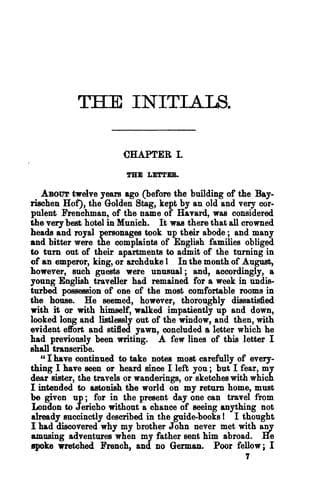
The Initials: A Story of Modern LifeTautphoeus, Jemima Montgomery, Baroness
General
The Initials: A Story of Modern Life
Tautphoeus, Jemima Montgomery, Baroness
Bavaria (Germany) -- Fiction; British -- Germany -- Fiction; Love stories
Poor Crescenz had been condemned to a place between her mother and Major
Stultz. Hildegarde had emancipated herself completely; she hung on her
proud father’s arm, walked about the rooms, and talked unrestrainedly.
Hamilton had to seek her when the music again commenced; she left her
father directly, and walked towards the dancing-room, but scarcely had
she entered it when Count Raimund approached, exclaiming, “Where are you
going, Hildegarde? do not forget that this galop is mine.”
“No, Oscar, it was the second that I promised you.”
“That cannot be, Hildegarde, for I am engaged to dance it with a—Marie.
I believe—I am quite certain—you promised me this one.”
“And I am _quite sure_, Oscar, that you are mistaken. _Quite sure!_”
began Hildegarde, with her usual decision of manner, but the angry
expression of her cousin’s countenance made her hesitate. “Perhaps,
however,” she added, looking from one to the other, “perhaps, as Mr.
Hamilton is an Englishman, and does not care about dancing, he will be
rather pleased than otherwise in being released from what he probably
considered a duty dance.”
“By no means,” said Hamilton, firmly holding the hand which she
endeavoured to withdraw, “I am not so indifferent as you seem to
imagine. You have promised to dance with me, and I am not disposed to
release you from your engagement.”
“Nor I, either,” said Count Raimund, while the blood mounted to his
temples, and was even visible under the roots of his fair hair.
“You think, perhaps, I ought to feel flattered,” said Hildegarde,
scornfully, “but I do not—on the contrary I think you both, I mean to
say—Oscar extremely disagreeable. I shall not dance with either of you,”
she added, seating herself on a bench, and beginning to tap her foot
impatiently on the floor. The two young men placed themselves on either
side of her.
“I hope,” she said, turning to Count Raimund, “I hope you are satisfied,
now that you have deprived me of the pleasure of dancing a galop, to
which I have been looking forward for the last half hour?”
“My satisfaction depends entirely on who the person may be with whom you
anticipated so much pleasure in dancing.”
“You know perfectly well that I was not engaged to you, and did not
think of you.”
Count Raimund played with the hilt of his sword, which he had laid on
the form beside him.
“Oscar,” continued Hildegarde, after a pause, in a low voice, “don’t be
so unjust, so tyrannical as to deprive me of my galop. Choose somebody
else. See, there is Marie still disengaged—go quickly, before anyone
else can——”
“Thank you,” said Raimund, interrupting her; “you are very kind, but I
have no inclination whatever that way. Marie may be very good for
household purposes, but I must say I rejoice in the idea that our
marriage will free me from these ball-room duties towards a person I
have scarcely learned to tolerate. In fact, I believe I detest her, so
has she been forced upon me!”
Public-domain text, read in full here on John Shaqi.
Reviews
Reviews
No reviews yet
Be the first to share your thoughts on this work.
Elsewhere in the archive
Join the Discussion
Join the discussion
Sign in to leave a comment or review.
Sign InorCreate an account