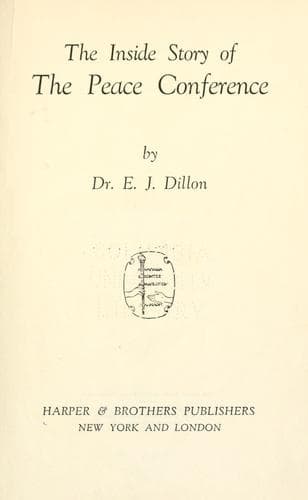
The Inside Story of the Peace ConferenceDillon, Emile Joseph
History
The Inside Story of the Peace Conference
Dillon, Emile Joseph
Paris Peace Conference (1919-1920)
Indeed, it is hardly too much to affirm
that empiricism and opportunism were among the principal characteristics
of his policy in Paris, and that the outcome was what it must be.
Disputes and delays being inevitable, the Conference began its work at
leisure and was forced to terminate it in hot haste. Having spent months
chaffering, making compromises, and unmaking them again while the
peoples of the world were kept in painful suspense, all of them
condemned to incur ruinous expenditure and some to wage sanguinary wars,
the springs of industrial and commercial activity being kept sealed, the
delegates, menaced by outbreaks, revolts, and mutinies, began, after
months had been wasted, to speed up and get through their work without
adequate deliberation. They imagined that they could make up for the
errors of hesitancy and ignorance by moments of lightning-like
improvisation. Improvisation and haphazard conclusions were among their
chronic failings. Even in the early days of the Conference they had
promulgated decisions, the import and bearings of which they missed, and
when possible they canceled them again. Sometimes, however, the error
committed was irreparable. The fate reserved for Austria was a case in
point. By some curious process of reasoning it was found to be not
incompatible with the Wilsonian doctrine that German-Austria should be
forbidden to throw in her lot with the German Republic, this prohibition
being in the interest of France, who could not brook a powerful united
Teuton state. The wishes of the Austrian-Germans and the principle of
self-determination accordingly went for nothing. The representations of
Italy, who pleaded for that principle, were likewise brushed aside.
But what the delegates appear to have overlooked was the decisive
circumstance that they had already "on strategic grounds" assigned the
Brenner line to Italy and together with it two hundred and twenty
thousand Tyrolese of German race living in a compact mass--although a
much smaller alien element was deemed a bar to annexation in the case of
Poland. And what was more to the point, this allotment deprived Tyrol of
an independent economic existence, cutting it off from the southern
valley and making it tributary to Bavaria. Mr. Wilson, the public was
credibly informed, "took this grave decision without having gone deeply
into the matter, and he repents it bitterly. None the less, he can no
longer go back."[97]
Just as Tyrol's loss of Botzen and Meran made it dependent on Bavaria,
so the severance of Vienna from southern Moravia--- the source of its
cereal supplies, situated at a distance of only thirty-six
miles--transformed the Austrian capital into a head without a body. But
on the eminent anatomists who were to perform a variety of unprecedented
operations on other states, this spectacle had no deterrent effect.
Public-domain text, read in full here on John Shaqi.
Reviews
Reviews
No reviews yet
Be the first to share your thoughts on this work.
Elsewhere in the archive
Join the Discussion
Join the discussion
Sign in to leave a comment or review.
Sign InorCreate an account