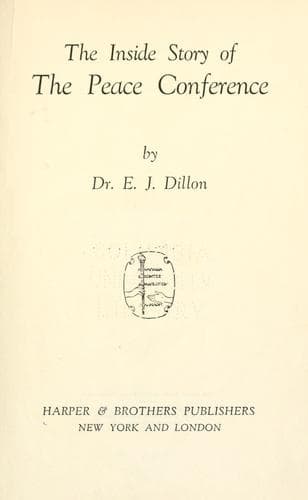
The Inside Story of the Peace ConferenceDillon, Emile Joseph
History
The Inside Story of the Peace Conference
Dillon, Emile Joseph
Paris Peace Conference (1919-1920)
These battles waged within the walls of the palace on the Quai d'Orsay
were discussed out-of-doors by an interested and watchful public, and
the conviction was profound and widespread that the President, having
set his hand to the plow so solemnly and publicly, and having promised a
harvest of far-reaching reforms, would not look back, however
intractable the ground and however meager the crop. But confronted with
serious obstacles, he flinched from his task, and therein, to my
thinking, lay his weakness. If he had come prepared to assert his
personal responsibility, to unfold his scheme, to have it amply and
publicly discussed, to reject pusillanimous compromise in the sphere of
execution, and to appeal to the peoples of the world to help him to
carry it out, the last phase of his policy would have been worthy of
the first, and might conceivably have inaugurated the triumph of the
ideas which the indolent and the men of little faith rejected as
incapable of realization. To this hardy course, which would have
challenged the approbation of all that is best in the world, there was
an alternative: Mr. Wilson might have confessed that his judgment was at
fault, mankind not being for the moment in a fitting mood to practise
the new tenets, that a speedy peace with the enemy was the first and
most pressing duty, and that a world-parliament should be convened for a
later date to prepare the peoples of the universe for the new ordering.
But he chose neither alternative. At first it was taken for granted that
in the twilight of the Conference hall he had fought valiantly for the
principles which he had propounded as the groundwork of the new
politico-social fabric, and that it was only when he found himself
confronted with the insuperable antagonism of his colleagues of France
and Britain that he reluctantly receded from his position and resolved
to show himself all the more unbending to the envoys of the lesser
countries. But this assumption was refuted by State-Secretary Lansing,
who admitted to the Senate Foreign Relations Committee that the
President's Fourteen Points, which he had vowed to carry out, were not
even discussed at the Conference. The outcome of this attitude--one
cannot term it a policy--was to leave the best of the ideas which he
stood for in solution, to embitter every ally except France and Britain,
and to scatter explosives all over the world.
Public-domain text, read in full here on John Shaqi.
Reviews
Reviews
No reviews yet
Be the first to share your thoughts on this work.
Elsewhere in the archive
Join the Discussion
Join the discussion
Sign in to leave a comment or review.
Sign InorCreate an account