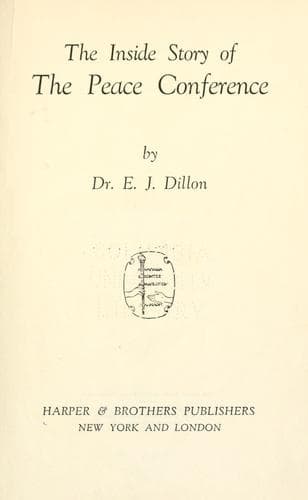
The Inside Story of the Peace ConferenceDillon, Emile Joseph
History
The Inside Story of the Peace Conference
Dillon, Emile Joseph
Paris Peace Conference (1919-1920)
In truth, it was difficult to follow the distinguished American
idealist, because one seldom knew whither he would lead. Neither,
apparently, did he himself. Some of his own countrymen in Paris held
that he had always been accustomed to follow, never to guide. Certainly
at the Conference his practice was to meet the more powerful of his
contradictors on their own ground and come to terms with them, so as to
get at least a part of what he aimed at, and that he accepted, even when
the instalment was accorded to him not as such, but as a final
settlement. So far as one can judge by his public acts and by the
admissions of State-Secretary Lansing, he cannot have seriously
contemplated staking the success of his mission on the realization of
his Fourteen Points. The manner in which he dealt with his Covenant,
with the French demand for concrete military guaranties and with secret
treaties, all afford striking illustrations of his easy temper. Before
quitting Paris for Washington he had maintained that the Covenant as
drafted was satisfactory, nay, he contended that "not even a period
could be changed in the agreement." The Monroe Doctrine, he held, needed
no special stipulation. But as soon as Senator Lodge and others took
issue with him on the subject, he shifted his position and hedged that
doctrine round with defenses which cut off a whole continent from the
purview of the League, which is nothing if not cosmic in its
functions.[115] Again, there was to be no alliance. The French Premier
foretold that there would be one. Mr. Wilson, who was in England at the
time, answered him in a speech declaring that the United States would
enter into no alliance which did not include all the world: "no
combination of power which is not a combination of all of us." Well,
since then he became a party to a kind of triple alliance and in the
judgment of many observers it constitutes the main result of the
Conference. In the words of an American press organ: "Clemenceau got
virtually everything he asked. President Wilson virtually dropped his
own program, and adopted the French and British, both of them
imperialistic."[116]
Public-domain text, read in full here on John Shaqi.
Reviews
Reviews
No reviews yet
Be the first to share your thoughts on this work.
Elsewhere in the archive
Join the Discussion
Join the discussion
Sign in to leave a comment or review.
Sign InorCreate an account