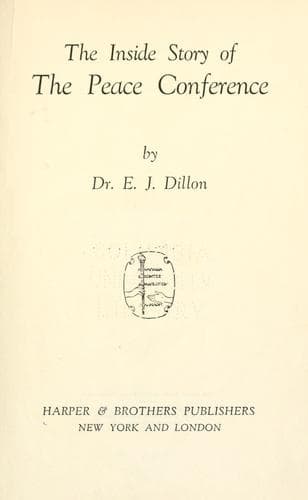
The Inside Story of the Peace ConferenceDillon, Emile Joseph
History
The Inside Story of the Peace Conference
Dillon, Emile Joseph
Paris Peace Conference (1919-1920)
At the Conference each state was dealt with according to its class.
Entirely above the new law, as we saw, stood its creators, the
Anglo-Saxons. To all the others, including the French, the Wilsonian
doctrine was applied as fully as was compatible with its author's main
object, the elaboration of an instrument which he could take back with
him to the United States as the great world settlement. Within these
limits the President was evidently most anxious to apply his Fourteen
Points, but he kept well within these. Thus he would, perhaps, have been
quite ready to insist on the abandonment by Britain of her supremacy on
the seas, on a radical change in the international status of Egypt and
Ireland, and much else, had these innovations been compatible with his
own special object. But they were not. He was apparently minded to test
the matter by announcing his resolve to moot the problem of the freedom
of the seas, but when admonished by the British government that it would
not even brook its mention, he at once gave it up and, presumably
drawing the obvious inference from this downright refusal, applied it to
the Irish, Egyptian, and other issues, which were forthwith eliminated
from the category of open or international problems. But France's
insistent demand, on the other hand, for the Rhine frontier met with an
emphatic refusal.[127]
The social reformer is disheartened by the one-sided and inexorable way
in which maxims proclaimed to be of universal application were
restricted to the second-class nations.
Russia's case abounds in illustrations of this arbitrary, unjust, and
impolitic pressure. The Russians had been our allies. They had fought
heroically at the time when the people of the United States were,
according to their President, "too proud to fight." They were essential
factors in the Allies' victory, and consequently entitled to the
advantages and immunities enjoyed by the Western Powers. In no case
ought they to have been placed on the same level as our enemies, and in
lieu of recompense condemned to punishment. And yet this latter
conception of their deserts was not wholly new. Soon after their
defection, and when the Allies were plunged in the depths of
despondency, a current of opinion made itself felt among certain
sections of the Allied peoples tending to the conclusion of peace on the
basis of compensations to Germany, to be supplied by the cession of
Russian territory. This expedient was advocated by more than one
statesman, and was making headway when fresh factors arose which bade
fair to render it needless.
Public-domain text, read in full here on John Shaqi.
Reviews
Reviews
No reviews yet
Be the first to share your thoughts on this work.
Elsewhere in the archive
Join the Discussion
Join the discussion
Sign in to leave a comment or review.
Sign InorCreate an account