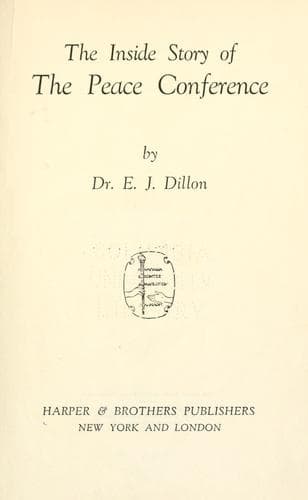
The Inside Story of the Peace ConferenceDillon, Emile Joseph
History
The Inside Story of the Peace Conference
Dillon, Emile Joseph
Paris Peace Conference (1919-1920)
among his foreign colleagues that it was only by dint of wordy warfare
and stubbornness that he finally won his point.
The stipulation for which the first British delegate toiled thus
laboriously was that within a fortnight after the ratification of the
Treaty the German and Polish forces should evacuate the districts in
which the plebiscite was to be held, that the Workmen's Councils there
should be dissolved, and that the League of Nations should take over the
government of the district so as to allow the population to give full
expression to its will. But the League of Nations did not exist and
could not be constituted for a considerable time. It was therefore
decided[131] that some temporary substitute for the League should be
formed at once, and the Supreme Council decided that Inter-Allied troops
should occupy the districts. That was the first instalment of the price
to be paid for the British Premier's tenderness for plebiscites, which
the expert commissions deprecated as unnecessary, and which, as events
proved in this case, were harmful.
In the meanwhile Bolshevist--some said German--agents were stirring up
the population by suasion and by terrorism until it finally began to
ferment. Thousands of working-men responded to the goad, "turned down"
their tools and ceased work. Thereupon the coal-fields of Upper Silesia,
the production of which had already dropped by 50 per cent, since the
preceding November, ceased to produce anything. This consummation
grieved the Supreme Council, which turned for help to the Inter-Allied
armies. For the Silesian coal-fields represented about one-third of
Germany's production, and both France and Italy were looking to Germany
for part of their fuel-supply. The French press pertinently asked
whether it would not have been cheaper, safer, and more efficacious to
have forgone the plebiscite and relied on the Polish troops from the
outset.[132] For, however ideal the intentions of Mr. Lloyd George may
have been, the net result of his insistence on a plebiscite was to
enable an ex-newspaper vender named Hoersing, who had undertaken to
prevent the detachment of Upper Silesia from Germany, to set his
machinery for agitation in motion and cause general unrest in the
Silesian and Dombrova coal-mining districts. When the strike was
declared the workmen, who are Poles to a man, rejected all suggestions
that they should refer their grievances to arbitration courts. For these
tribunals were conducted by Germans. The consequence of Mr. Lloyd
George's spirited intervention was, in the words of an unbiased
observer, to "raise the specters of starvation, freezing and Bolshevism
in eastern Europe" during the ensuing winter--a heavy price to pay for
pedantic adherence to the letter of an irrelevant ordinance, at a moment
when the spirit of basic principles was being allowed to evaporate.
Public-domain text, read in full here on John Shaqi.
Reviews
Reviews
No reviews yet
Be the first to share your thoughts on this work.
Elsewhere in the archive
Join the Discussion
Join the discussion
Sign in to leave a comment or review.
Sign InorCreate an account