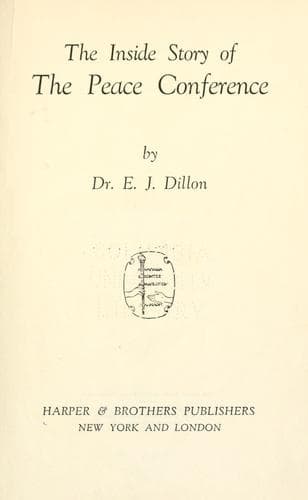
The Inside Story of the Peace ConferenceDillon, Emile Joseph
History
The Inside Story of the Peace Conference
Dillon, Emile Joseph
Paris Peace Conference (1919-1920)
It is worth while pursuing this matter a step farther. The Federal
Council in Berne having soon afterward officially recommended[138] the
nation to enter the League which guarantees it neutrality,[139] an
illuminating discussion ensued. And it was elicited that as there is an
obligation imposed on all member-states to execute the decrees of the
League for the coercion of rebellious fellow-members, it follows that in
such cases Switzerland, too, would be obliged to take an active part in
the struggle between the League and the recalcitrant country. From
military operations, however, Switzerland is dispensed, but it would
certainly be bound to adopt economic measures of pressure, and to this
extent abandon its neutrality. Now not only would that attitude be
construed by the disobedient nation as unfriendly, and the usual
consequences drawn from it, but as Switzerland is freed from military
co-operation, it follows that the League could not fix the headquarters
of its military command in its own capital, Geneva, as that would
constitute a violation of Swiss neutrality. And, if it did, Switzerland
would in self-defense be bound to oppose the decision!
The Belgians were discouraged by the disdainful demeanor and grudging
disposition of the Supreme Council, and irritated by the arbitrariness
of its decrees and the indefensible way in which it applied principles
that were propounded as sacred. Before restoring the diminutive cantons
of Eupen and Malmedy to Belgium, for example, Mr. Wilson insisted on
ascertaining the will of the population by plebiscite. In itself the
measure was reasonable, but the position of these little districts was
substantially on all-fours with Alsace-Lorraine, which was restored to
France without any such test. In Fiume, also, the will of the
inhabitants went for nothing, Mr. Wilson refusing to consult them.
Further, Austria, whose people were known to favor union with Germany,
was systematically jockeyed into ruinous isolation. "Now what, in the
light of these conflicting judgments," asked the Belgians, "is the true
meaning of the principle of self-determination?" The only reply they
received was that Mr. Wilson was right when he told his
fellow-countrymen that his principles stood in need of interpretation,
and that, as he was the sole authorized interpreter, his presence was
required in Europe.
Public-domain text, read in full here on John Shaqi.
Reviews
Reviews
No reviews yet
Be the first to share your thoughts on this work.
Elsewhere in the archive
Join the Discussion
Join the discussion
Sign in to leave a comment or review.
Sign InorCreate an account