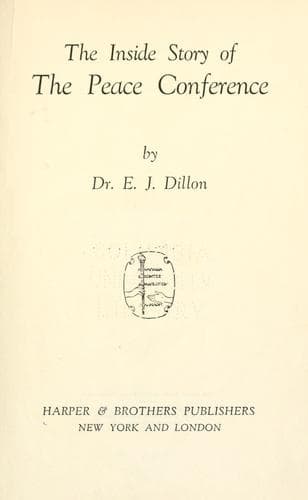
The Inside Story of the Peace ConferenceDillon, Emile Joseph
History
The Inside Story of the Peace Conference
Dillon, Emile Joseph
Paris Peace Conference (1919-1920)
When the commissions to which all the complex problems had to be
referred were being first created,[142] the lesser states were allowed
only five representatives on the Financial and Economic commissions, and
were bidden to elect them. The nineteen delegates of these States
protested on the ground that this arrangement would not give them
sufficient weight in the councils by which their interests would be
discussed. These malcontents were headed by Senhor Epistacio Pessoa, the
President-elect of the United States of Brazil. The Polish delegate, M.
Dmowski, addressing the meeting, suggested that they should not proceed
to an election, the results of which might stand in no relation to the
interests which the states represented had in matters of European
finance, but that they should ask the Great Powers to appoint the
delegates. To this the President-elect of Brazil demurred, taking the
ground that it would be undignified for the lesser states to submit to
have their spokesman nominated by the greater. Thereupon they elected
five delegates, all of them from South American countries, to deal with
European finance, leaving the Europeans to choose five from among
themselves. This would have given ten in all to the communities whose
interests were described as limited, and was an affront to the Great
Powers.
This comedy was severely judged and its authors reprimanded by the heads
of the Conference, who, while quashing the elections, relented to the
extent of promising that extra delegates might be appointed for the
lesser nations later on. As a matter of fact, the number of commissions
was of no real consequence, because on all momentous issues their
findings, unless they harmonized with the decisions of the chief
plenipotentiaries, were simply ignored.
The curious attitude of the Supreme Council toward Rumania may be
contemplated from various angles of vision. But the safest coign of
vantage from which to look at it is that formed by the facts.
Public-domain text, read in full here on John Shaqi.
Reviews
Reviews
No reviews yet
Be the first to share your thoughts on this work.
Elsewhere in the archive
Join the Discussion
Join the discussion
Sign in to leave a comment or review.
Sign InorCreate an account