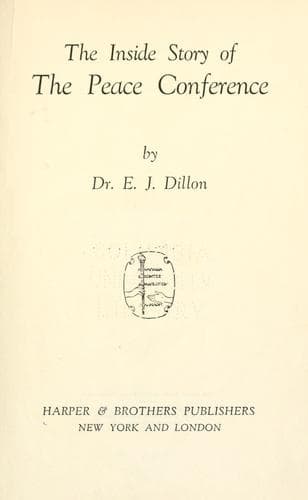
The Inside Story of the Peace ConferenceDillon, Emile Joseph
History
The Inside Story of the Peace Conference
Dillon, Emile Joseph
Paris Peace Conference (1919-1920)
and that loans accepted on onerous conditions would, as was hinted, have
softened the hearts of those who had it in their power to render the
existence of the nation sour or sweet.[144] "Look out," exclaimed a
Rumanian to me. "You will see that we shall be spurned as Laodiceans,
or worse, before the Conference is over." Rumania's external situation
was even more perilous than her domestic plight. Situated between Russia
and Hungary, she came more and more to resemble the iron between the
hammer and the anvil. A well-combined move of the two anarchist states
might have pulverized her. Alive to the danger, her spokesmen in Paris
were anxious to guard against it, but the only hope they had at the
moment was centered in the Great Powers, whose delegates at the
Conference were discharging the functions which the League of Nations
would be called on to fulfil whenever it became a real institution. And
their past experience of the Great Powers' mode of action was not
calculated to command their confidence. It was the Great Powers which,
for their own behoof and without the slightest consideration for the
interests of Rumania, had constrained that country to declare war
against the Central Empires[145] and had made promises of effective
support in the shape of Russian troops, war material of every kind,
officers, and heavy artillery. But neither the promises of help nor the
assurances that Germany's army of invasion would be immobilized were
redeemed, and so far as one can now judge they ought never to have been
made. For what actually came to pass--the invasion of the country by
first-class German armies under Mackensen--might easily have been
foreseen, and was actually foretold.[146] The entire country was put to
sack, and everything of value that could be removed was carried off to
Hungary, Germany, or Austria. The Allies lavished their verbal
sympathies on the immolated nation, but did little else to succor it,
and want and misery and disease played havoc with the people.
Public-domain text, read in full here on John Shaqi.
Reviews
Reviews
No reviews yet
Be the first to share your thoughts on this work.
Elsewhere in the archive
Join the Discussion
Join the discussion
Sign in to leave a comment or review.
Sign InorCreate an account