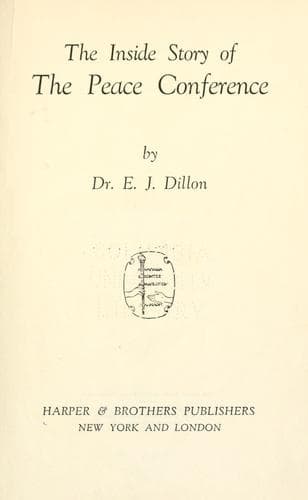
The Inside Story of the Peace ConferenceDillon, Emile Joseph
History
The Inside Story of the Peace Conference
Dillon, Emile Joseph
Paris Peace Conference (1919-1920)
For it was assumed that they still regarded the
Bolshevist leaders as outlaws. One explanation was that they objected to
allow the Rumanian army alone to occupy the Hungarian capital. But that
would not account for their neglect to despatch an Inter-Allied
contingent to restore order in the city and country. For they remained
absolutely inactive while Kuhn's supporters were rallying and
consolidating their scattered and demoralized forces, and they kept the
Rumanians from balking the Bolshevist work of preparing another attack.
As one of their French critics[148] remarked, they dealt exclusively in
negatives--some of them pernicious enough, whereas a positive policy
was imperatively called for. To reconstruct a nation, not to say a
ruined world, a series of contradictory vetoes is hardly sufficient. But
another explanation of their attitude was offered which gained
widespread acceptance. It will be unfolded presently.
The dispersed Bolshevist army, thus shielded, soon recovered its nerve,
and, feeling secure on the Rumanian front, where the Allies held the
invading troops immobilized, attacked the Slovaks and overran their
country. For Bolshevism is by nature proselytizing. The Prague Cabinet
was dismayed. The new-born Czechoslovak state was shaken. A catastrophe
might, as it seemed, ensue at any moment. Rumania's troops were on the
watch for the signal to resume their march, but it came not. The
Czechoslovaks were soliciting it prayerfully. But the weak-kneed
plenipotentiaries in Paris were minded to fight, if at all, with weapons
taken from a different arsenal. In lieu of ordering the Rumanian troops
to march on Budapest, they addressed themselves to the Bolshevist
leader, Kuhn, summoned him to evacuate the Slovak country, and
volunteered the promise that they would compel the Rumanians to
withdraw. This amazing line of action was decided on by the secret
Council of Three without the assent or foreknowledge of the nation to
whose interests it ran counter and the head of whose government was
rubbing shoulders with the plenipotentiaries every day. But M.
Bratiano's existence and that of his fellow-delegate was systematically
ignored. It is not easy to fathom the motives that inspired this
supercilious treatment of the spokesman of a nation which was
sacrificing its sons in the service of the Allies as well as its own.
Personal antipathy, however real, cannot be assumed without convincing
grounds to have been the mainspring.
Public-domain text, read in full here on John Shaqi.
Reviews
Reviews
No reviews yet
Be the first to share your thoughts on this work.
Elsewhere in the archive
Join the Discussion
Join the discussion
Sign in to leave a comment or review.
Sign InorCreate an account