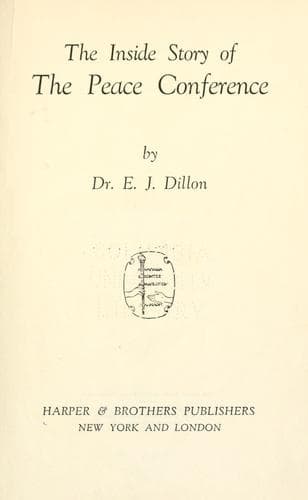
The Inside Story of the Peace ConferenceDillon, Emile Joseph
History
The Inside Story of the Peace Conference
Dillon, Emile Joseph
Paris Peace Conference (1919-1920)
The fact could not be blinked that in the camp of the Allies there was a
serious schism. The partizans of the Supreme Council accused the
Bucharest government of secession, and were accused in turn of having
misled their Rumanian partners, of having planned to exploit them
economically, of having favored their Bolshevist invaders, and pursued a
policy of blackmail. The rights and wrongs of this quarrel had best be
left to another tribunal. What can hardly be gainsaid is that in a
general way the Rumanians--and not these alone--were implicitly classed
as people of a secondary category, who stood to gain by every measure
for their good which the culture-bearers in Paris might devise. These
inferior nations were all incarnate anachronisms, relics of dark ages
which had survived into an epoch of democracy and liberty, and it now
behooved them to readjust themselves to that. Their institutions must be
modernized, their Old World conceptions abandoned, and their people
taught to imitate the progressive nations of the West. What the
populations thought and felt on the subject was irrelevant, they being
less qualified to judge what was good for them than their
self-constituted guides and guardians. To the angry voices which their
spokesmen uplifted no heed need be paid, and passive resistance could be
overcome by coercion. This modified version of Carlyle's doctrine would
seem to be at the root of the Supreme Council's action toward the lesser
nations generally and in especial toward Rumania.
POLAND AND THE SUPREME COUNCIL
Public-domain text, read in full here on John Shaqi.
Reviews
Reviews
No reviews yet
Be the first to share your thoughts on this work.
Elsewhere in the archive
Join the Discussion
Join the discussion
Sign in to leave a comment or review.
Sign InorCreate an account