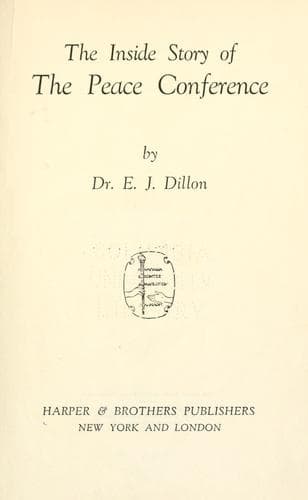
The Inside Story of the Peace ConferenceDillon, Emile Joseph
History
The Inside Story of the Peace Conference
Dillon, Emile Joseph
Paris Peace Conference (1919-1920)
Consciousness of these disadvantages may have had much to do with the
rigid secrecy which the delegates maintained before their desultory
talks ripened into discussions. In the case of Poland, as of Rumania,
the veil was opaque, and was never voluntarily lifted. One day[179] the
members of the Polish delegation, eager to get an inkling of what had
been arranged by the Council of Four about Dantzig, requested M.
Clemenceau to apprize them at least of the upshot if not of the details.
The French Premier, who has a quizzing way and a keen sense of humor,
replied, "On the 26th inst. you will learn the precise terms." But
Poland's representative insisted and pleaded suasively for a hint of
what had been settled. The Premier finally consented and said, "Tell the
General Secretary of the Conference, M. Dutasta, from me, that he may
make the desired communication to you." The delegate accordingly
repaired to M. Dutasta, preferred his request, and received this reply:
"M. Clemenceau may say what he likes. His words do not bind the
Conference. Before I consider myself released from secrecy I must have
the consent of all his colleagues as well. If you would kindly bring me
their express authorization I will communicate the information you
demand." That closed the incident.
When the Council finally agreed to a solution, the delegates were
convoked to learn its nature and to make a vow of obedience to its
decisions. During the first stage of the Conference the representatives
of the lesser states had sometimes been permitted to put questions and
present objections. But later on even this privilege was withdrawn. The
following description of what went on may serve as an illustration of
the Council's mode of procedure. One day the Polish delegation was
summoned before the Special Commission to discuss an armistice between
the Ruthenians of Galicia and the Polish Republic. The late General
Botha, a shrewd observer, whose valuable experience of political
affairs, having been confined to a country which had not much in common
with eastern Europe, could be of little help to him in solving the
complex problems with which he was confronted, was handicapped from the
outset. Unacquainted with any languages but English and Dutch, the
general had to surmount the additional difficulty of carrying on the
conversation through an interpreter. The form it took was somewhat as
follows:
Public-domain text, read in full here on John Shaqi.
Reviews
Reviews
No reviews yet
Be the first to share your thoughts on this work.
Elsewhere in the archive
Join the Discussion
Join the discussion
Sign in to leave a comment or review.
Sign InorCreate an account