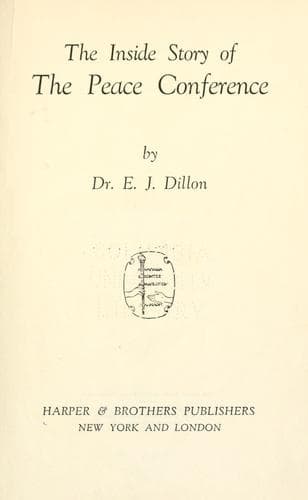
The Inside Story of the Peace ConferenceDillon, Emile Joseph
History
The Inside Story of the Peace Conference
Dillon, Emile Joseph
Paris Peace Conference (1919-1920)
General Botha, thereupon adopting an emotional tone, said: "I have one
last appeal to make to you. It behooves Poland to lift the question from
its present petty surroundings and set it in the larger frame of world
issues. What we are aiming at is the overthrow of militarism and the
cessation of bloodshed. As a civilized nation Poland must surely see eye
to eye with the Supreme Council how incumbent it is on the Allies to put
a stop to the misery that warfare has brought down on the world and is
now inflicting on the populations of Poland and eastern Galicia."
"Truly," replied the Polish delegate, "and so thoroughly does she
realize it that it is repugnant to her to be satisfied with a sham
peace, a mere pause during which a bloodier war may be organized. We
want a settlement that really connotes peace, and our intimate knowledge
of the circumstances enables us to distinguish between that and a mere
truce. That is the ground of our insistence."
"Bear well in mind," insisted the Boer general, "the friendly attitude
of the great Allies toward your country at a critical period of its
history. They restored it. They meant and mean to help it to preserve
its status. It behooves the Poles to show their appreciation of this
friendship in a practical way by deferring to their wishes. Everything
they ordain is for your good. Realize that and carry out their schemes."
"For their help we are and will remain grateful," was the answer, "and
we will go as far toward meeting their wishes as is feasible without
actually imperiling their contribution to the restoration of our state.
But we cannot blink the facts that their views are sometimes mistaken
and their power to realize them generally imaginary. They have made
numerous and costly mistakes already, which they now frankly avow. If
they persisted in their present plan they would be adding another to the
list. And as to their power to help us positively, it is nil. Their
initial omission to send a formidable military force to Poland was an
irreparable blunder, for it left them without an executive in eastern
Europe, where they now can help none of their protégées against their
respective enemies. Poles, Rumanians, Jugoslavs are all left to
themselves. From the Allies they may expect inspiriting telegrams, but
little else. In fact, the utmost they can do is to issue decrees that
may or may not be obeyed. Examples are many. They obtained for us by the
armistice the right of disembarking troops at Dantzig, and we were
unspeakably grateful to them. But they failed to make the Germans
respect that right and we had to resign ourselves to abandon it. They
ordered the Ukrainians to cease their numerous attacks on us and we
appreciated their thoughtfulness. But the order was disobeyed; we were
assailed and had no one to look to for help but ourselves. Still we are
most thankful for all that they could do. But if we concluded the
armistice which you are pleading for, this is what would happen: we
Public-domain text, read in full here on John Shaqi.
Reviews
Reviews
No reviews yet
Be the first to share your thoughts on this work.
Elsewhere in the archive
Join the Discussion
Join the discussion
Sign in to leave a comment or review.
Sign InorCreate an account