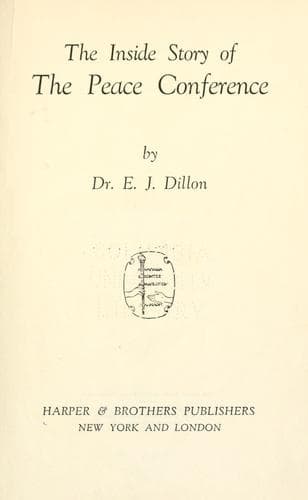
The Inside Story of the Peace ConferenceDillon, Emile Joseph
History
The Inside Story of the Peace Conference
Dillon, Emile Joseph
Paris Peace Conference (1919-1920)
But lucid intelligence, backed by unflagging will, was of no avail
against the threat of famine. The Poles had to give way. M. Paderewski
pledged his word to Messrs. Lloyd George and Wilson that he would have
an armistice concluded with the Ruthenians of eastern Galicia, and the
Duumvirs rightly placed implicit confidence in his word as in his moral
rectitude. They also felt grateful to him for having facilitated their
arduous task by accepting the inevitable. To my knowledge President
Wilson himself addressed a letter to him toward the end of April,
thanking him cordially for the broad-minded way in which he had
co-operated with the Supreme Council in its efforts to reconstitute his
country on a solid basis. Probably no other representative of a state
"with limited interests" received such high mark of approval.
M. Paderewski left Paris for Warsaw, there to win over the Cabinet. But
in Poland, where the authorities were face to face with the concrete
elements of the problem, the Premier found no support. Neither the
Cabinet nor the Diet nor the head of the state found it possible to
redeem the promise made in their name. Circumstance was stronger than
the human will. M. Paderewski resigned. The Ruthenians delivered a
timely attack on the Poles, who counter-attacked, captured the towns of
Styra, Tarnopol, Stanislau, and occupied the enemy country right up to
Rumania, with which they desired to be in permanent contact. Part of the
Ruthenian army crossed the Czech frontier and was disarmed, the
remainder melted away, and there remained no enemy with whom to conclude
an armistice.
For the "Big Four" this turn of events was a humiliation. The Ruthenian
army, whose interests they had so taken to heart, had suddenly ceased to
exist, and the future danger which it represented to Poland was seen to
have been largely imaginary. Their judgment was at fault and their power
ineffectual. Against M. Paderewski's impotence they blazed with
indignation. He had given way to their decision and promptly gone to
Warsaw to see it executed, yet the conditions were such that his words
were treated as sounding brass or a tinkling cymbal. The Polish
Premier, it is true, had tendered his resignation in consequence, but it
was refused--and even had it been accepted, what was the retirement of a
Minister as compared with the indignity put upon the world's lawgivers
who represented power and interests which were alike unlimited? Angry
telegrams were flashed over the wires from Paris to Warsaw and the
Polish Premier was summoned to appear in Paris without delay. He duly
returned, but no new move was made. The die was cast.
Public-domain text, read in full here on John Shaqi.
Reviews
Reviews
No reviews yet
Be the first to share your thoughts on this work.
Elsewhere in the archive
Join the Discussion
Join the discussion
Sign in to leave a comment or review.
Sign InorCreate an account