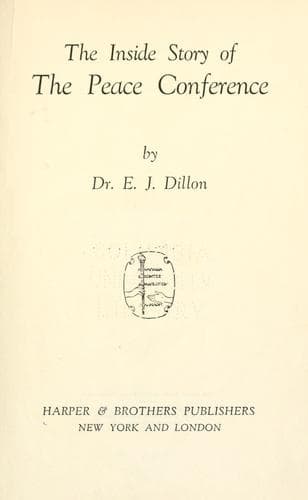
The Inside Story of the Peace ConferenceDillon, Emile Joseph
History
The Inside Story of the Peace Conference
Dillon, Emile Joseph
Paris Peace Conference (1919-1920)
Much might have been urged against this proffered solace if the
delegates had been in a captious mood. The League of Nations had as yet
no existence. If its will, intelligence, and power could indeed be
reckoned upon with such confidence, how had it come to pass that its
creators, Britain and the United States, deemed them dubious enough to
call for a reinforcement in the shape of a formal alliance for the
protection of France? If this precautionary measure, which shatters the
whole Wilsonian system, was indispensable to one Ally it was at least
equally indispensable to another. And in the case of Poland it was more
urgent than in the case of France, because if Germany were again to
scheme a war of conquest the probability is infinitesimal that she would
invade Belgium or move forward on the western front. The line of least
resistance, which is Poland, would prove incomparably more attractive.
And then? The absence of Allied troops in eastern Europe was one of the
principal causes of the wars, tumults, and chaotic confusion that had
made nervous people tremble for the fate of civilization in the interval
between the conclusion of the armistice and the ratification of the
Treaty. In the future the absence of strongly situated Allies there, if
Germany were to begin a fresh war, would be more fatal still, and the
Polish state might conceivably disappear before military aid from the
Allied governments could reach it. Why should the safety of Poland and
to some extent the security of Europe be made to depend upon what is at
best a gambler's throw?
Public-domain text, read in full here on John Shaqi.
Reviews
Reviews
No reviews yet
Be the first to share your thoughts on this work.
Elsewhere in the archive
Join the Discussion
Join the discussion
Sign in to leave a comment or review.
Sign InorCreate an account