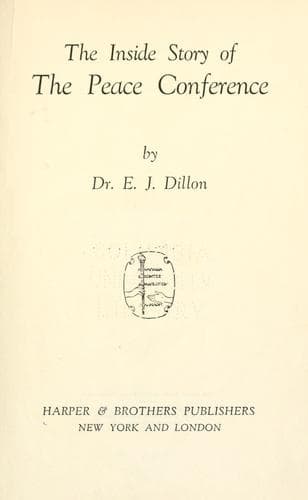
The Inside Story of the Peace ConferenceDillon, Emile Joseph
History
The Inside Story of the Peace Conference
Dillon, Emile Joseph
Paris Peace Conference (1919-1920)
"The Great Powers," observed the most outspoken of the delegates of the
lesser states, "are bandits, but as their operations are on a large
scale they are entitled to another and more courteous name. Their gaze
is fascinated by markets, concessions, monopolies. They are now making
preparations for a great haul. At this politicians cannot affect to be
scandalized. For it has never been otherwise since men came together in
ordered communities. But what is irritating and repellent is the perfume
of altruism and philanthropy which permeates this decomposition. We are
told that already they are purchasing the wharves of Dantzig, making
ready for 'big deals' in Libau, Riga, and Reval, founding a bank in
Klagenfurt and negotiating for oil-wells in Rumania. Although deeply
immersed in the ethics of politics, they have not lost sight of the
worldly goods to be picked up and appropriated on the wearisome journey
toward ideal goals. The atmosphere they have thus renewed is peculiarly
favorable to the growth of cant, and tends to accelerate the process of
moral and social dissolution. And the effects of this mephitic air may
prove more durable than the contribution of its creators to the
political reorganization of Europe. If we compare the high functions
which they might have fulfilled in relation to the vast needs and the
unprecedented tendencies of the new age with those which they have
unwittingly and deliberately performed as sophists of sentimental
morality and destroyers of the wheat together with the tares, we shall
have to deplore one of the rarest opportunities missed beyond retrieve."
In this criticism there is a kernel of truth. The ethico-social currents
to which the war gave rise had a profoundly moral aspect, and if rightly
canalized might have fertilized many lands and have led to a new and
healthy state-system. One indispensable condition, however, was that the
peoples of the world should themselves be directly interested in the
process, that they should be consulted and listened to, and helped or
propelled into new grooves of thought and action. Instead of that the
delegates contented themselves with giving new names to old institutions
and tendencies which stood condemned, and with teaching lawless
disrespect for every check and restraint except such as they chose to
acknowledge. They were powerful advocates for right and justice,
democracy and publicity, but their definitions of these abstract nouns
made plain-speaking people gasp. Self-interest and material power were
the idols which they set themselves to pull down, but the deities which
they put in their places wore the same familiar looks as the idols, only
they were differently colored.
FOOTNOTES:
[127] In February, 1919.
[128] The French Minister of Foreign Affairs, M. Pichon, undertook to
recognize in principle the independence of Esthonia, provided that
Esthonia would take over her part of the Russian debt.
Public-domain text, read in full here on John Shaqi.
Reviews
Reviews
No reviews yet
Be the first to share your thoughts on this work.
Elsewhere in the archive
Join the Discussion
Join the discussion
Sign in to leave a comment or review.
Sign InorCreate an account