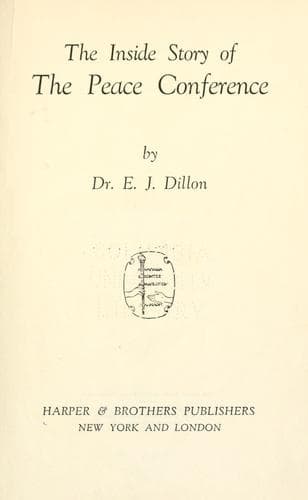
The Inside Story of the Peace ConferenceDillon, Emile Joseph
History
The Inside Story of the Peace Conference
Dillon, Emile Joseph
Paris Peace Conference (1919-1920)
Casting a parting glance at Poland as she looked when emerging from the
Conference in the leading-strings of the Great Western Powers, after
having escaped from the Bolshevist dangers that compassed her round, we
behold her about to begin her national existence as a semi-independent
nation, beset with enemies domestic and foreign. For it would be an
abuse of terms to affirm that Poland, or, indeed, any of the lesser
states, is fully independent in the old sense of the word. The special
treaty imposed on her by the Great Two obliges her to accord free
transit to Allied goods and certain privileges to her Jewish and other
minorities; to accept the supervision and intervention of the League of
Nations, which the Poles contend means in their case an
Anglo-Saxon-Jewish association; and, at the outset, at any rate, to
recognize the French generalissimus as the supreme commander of her
troops.
Poland's frontiers and general status ought, if the scheme of her French
protectors had been executed, to have been accommodated to the peculiar
functions which they destined her to fill in New Europe. France's plan
was to make of Poland a wall between Germany and Russia. The marked
tendency of the other two Conference leaders was to transform it into a
bridge between those two countries. And the outcome of the compromise
between them has been to construct something which, without being
either, combines all the disadvantages of both. It is a bridge for
Germany and a wall for Bolshevist Russia. That is the verdict of a large
number of Poles. Although the Europe of the future is to be a pacific
and ethically constituted community, whose members will have their
disputes and quarrels with one another settled by arbitration courts and
other conciliatory tribunals, war and efficient preparation for it were
none the less uppermost in the minds of the circumspect lawgivers. Hence
the Anglo-Saxon agreement to defend France against unprovoked
aggression. Hence, too, the solicitude displayed by the French to have
the Polish state, which is to be their mainstay in eastern Europe,
equipped with every territorial and other guaranty necessary to qualify
it for the duties. But what the French government contrived to obtain
for itself it failed to secure for its new Slav ally. Nay, oddly enough
it voted with the Anglo-Saxon delegates for keeping all the lesser
states under the tutelage of the League. The Duumvirs, having made the
requisite concessions to France, were resolved in Poland's case to avoid
a further recoil toward the condemned forms of the old system of
equilibrium. Hence the various plebiscites, home-rule charters,
subdivisions of territory, and other evidences of a struggle for reform
along the line of least resistance, as though in the unavoidable future
conflict between timidly propounded theories and politico-social forces
the former had any serious chance of surviving. In politics, as in
coinage, it is the debased metal that ousts the gold from circulation.
Public-domain text, read in full here on John Shaqi.
Reviews
Reviews
No reviews yet
Be the first to share your thoughts on this work.
Elsewhere in the archive
Join the Discussion
Join the discussion
Sign in to leave a comment or review.
Sign InorCreate an account