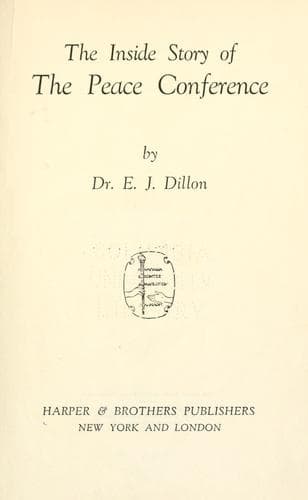
The Inside Story of the Peace ConferenceDillon, Emile Joseph
History
The Inside Story of the Peace Conference
Dillon, Emile Joseph
Paris Peace Conference (1919-1920)
her backers may conceivably be the result of racial affinities, but it
has hardly ever been ascribed to that sentimental source. Sentiment in
politics is a myth. In any case, M. Clemenceau discerned no pressing
reason for making painful efforts to perpetuate the Latin union, while
solicitude for national interests hindered him from making costly
concessions to it.
Naturally the cardinal innovation of which this was a corollary was
never invoked as the ground for any of the exceptional measures adopted
by the Conference. And yet it was the motive for several, for although
no allusion was made to the hegemony of Anglo-Saxondom, it was ever
operative in the subconsciousness of the two plenipotentiaries. And in
view of the omnipotence of these two nations, they temporarily
sacrificed consistency to tactics, probably without conscientious
qualms, and certainly without political misgivings. That would seem to
be a partial explanation of the lengths to which the Conference went in
the direction of concessions to the Great Powers' imperialist demands.
France asked to be recognized and treated as the personification of that
civilization for which the Allied peoples had fought. And for many
reasons, which it would be superfluous to discuss here, a large part of
her claim was allowed. This concession was attacked by many as connoting
a departure from principle, but the deviation was more apparent than
real, for under all the wrappings of idealistic catchwords lay the
primeval doctrine of force. The only substantial difference between the
old system and the new was to be found in the wielders of the force and
the ends to which they intended to apply it. Force remains the granite
foundation of the new ordering, as it had been of the old. But its
employment, it was believed, would be different in the future from what
it had been in the past. Concentrated in the hands of the
English-speaking peoples, it would become so formidable a weapon that it
need never be actually wielded. Possession of overwhelmingly superior
strength would suffice to enforce obedience to the decrees of its
possessors, which always will, it is assumed, be inspired by equity. An
actual trial of strength would be obviated, therefore, at least so long
as the relative military and economic conditions of the world states
underwent no sensible change. To this extent the war specter would be
exorcised and trying abuses abolished.
Public-domain text, read in full here on John Shaqi.
Reviews
Reviews
No reviews yet
Be the first to share your thoughts on this work.
Elsewhere in the archive
Join the Discussion
Join the discussion
Sign in to leave a comment or review.
Sign InorCreate an account