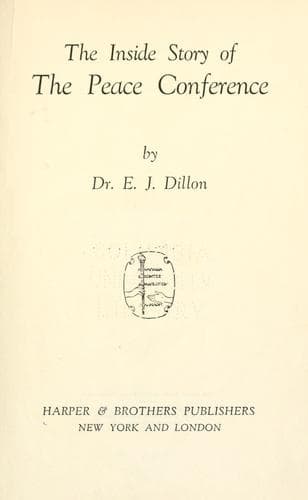
The Inside Story of the Peace ConferenceDillon, Emile Joseph
History
The Inside Story of the Peace Conference
Dillon, Emile Joseph
Paris Peace Conference (1919-1920)
It was certainly to Italy's best interests to strike up a friendly
agreement with the new state, if that were feasible, and some of the men
in whose hands her destinies rested, feeling their responsibility, made
a laudable attempt to come to an understanding. Signor Orlando, whose
sagacity is equal to his resourcefulness, was one. In London he had
talked the subject over with the Croatian leader, M. Trumbic, and
favored the movement toward reconciliation[205] which Baron Sonnino, his
colleague, as resolutely discouraged. A congress was accordingly held in
Rome[206] and an accord projected. The reciprocal relations became
amicable. The Jugoslav committee in the Italian capital congratulated
Signor Orlando on the victory of the Piave. But owing to various causes,
especially to Baron Sonnino's opposition, these inchoate sentiments of
neighborliness quickly lost their warmth and finally vanished. No trace
of them remained at the Paris Conference, where the delegates of the two
states did not converse together nor even salute one another.
President Wilson's visit to Rome, where, to use an Italian expression,
he was welcomed by Delirium, seemed to brighten Italy's outlook on the
future. Much was afterward made by the President's enemies of the
subsequent change toward him in the sentiments of the Italian people.
This is commonly ascribed to his failure to fulfil the expectations
which his words or attitude aroused or warranted. Nothing could well be
more misleading. Mr. Wilson's position on the subject of Italy's claims
never changed, nor did he say or do aught that would justify a doubt as
to what it was. In Rome he spoke to the Ministers in exactly the same
terms as in Paris at the Conference. He apprized them in January of what
he proposed to do in April and he even contemplated issuing a
declaration of his Italian policy at once. But he was earnestly
requested by the Ministers to keep his counsel to himself and to make no
public allusion to it during his sojourn in Italy.[207] It was not his
fault, therefore, if the Italian people cherished illusory hopes. In
Paris Signer Orlando had an important encounter with Mr. Wilson,[208]
who told him plainly that the allotment of the northern frontiers traced
for Italy by the London Treaty would be confirmed, while that of the
territory on the eastern Adriatic would be quashed. The division of the
spoils of Austria there must, he added, be made congruously with a map
which he handed to the Italian Premier. It was proved on examination to
be identical with one already published by the _New Europe_.[209] Signor
Orlando glanced at the map and in courteous phraseology unfolded the
reasons why he could not entertain the settlement proposed. He added
that no Italian parliament would ratify it. Thereupon the President
turned the discussion to politico-ethical lines, pointed out the harm
which the annexation of an alien and unfriendly element could inflict
Public-domain text, read in full here on John Shaqi.
Reviews
Reviews
No reviews yet
Be the first to share your thoughts on this work.
Elsewhere in the archive
Join the Discussion
Join the discussion
Sign in to leave a comment or review.
Sign InorCreate an account