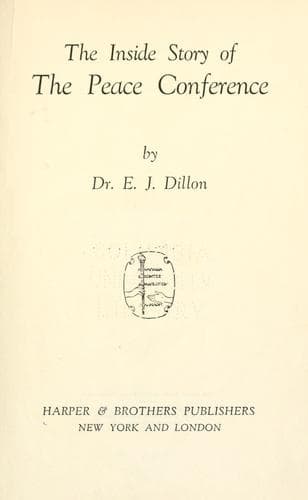
The Inside Story of the Peace ConferenceDillon, Emile Joseph
History
The Inside Story of the Peace Conference
Dillon, Emile Joseph
Paris Peace Conference (1919-1920)
In February the Jugoslavs made a strategic move, which many admired as
clever, and others blamed as unwise. They proposed that all differences
between their country and Italy should be submitted to Mr. Wilson's
arbitration. Considering that the President's mind was made up on the
subject from the beginning, and that he had decided against Italy, it
was natural that the delegation in whose favor his decision was known to
incline should be eager to get it accepted by their rivals. As neither
side was ignorant of what the result of the arbitration would be, only
one of the two could be expected to close with the offer, and the most
it could hope by doing this was to embarrass the other. The Italian
answer was ingenious. Their dispute, they said, was not with Serbia, who
alone was represented at the Conference; it concerned Croatia, who had
no official standing there, and whose frontiers were not yet determined,
but would in due time be traced by the Conference, of which Italy was a
member. The decision would be arrived at after an exhaustive study, and
its probable consequences to Europe's peace would be duly considered. As
extreme circumspection was imperative before formulating a verdict, five
plenipotentiaries would seem better qualified than any one of them, even
though he were the wisest of the group. To remove the question from the
competency of the Conference, which was expressly convoked to deal with
such issues, and submit it to an individual, would be felt as a slight
on the Supreme Council. And so the matter dropped.
Signor Orlando knew that if he had adopted the suggestion and made Mr.
Wilson arbiter, Italy's hopes would have been promptly extinguished in
the name of the Fourteen Points, and her example held up for all the
lesser states to imitate. The President was, however, convinced that the
Italian people would have ratified the arrangement with alacrity. It is
worth recording that he was so sure of his own hold on the Italian
masses that, when urging Signor Orlando to relinquish his demand for
Fiume and the Dalmatian coast, he volunteered to provide him with a
message written by himself to serve as the Premier's justification.
Signor Orlando was to read out this document in Parliament in order to
make it clear to the nation that the renunciation had been demanded by
America, that it would most efficaciously promote Italy's best
interests, and should for that reason be ratified with alacrity. Signor
Orlando, however, declined the certificate and things took their course.
Public-domain text, read in full here on John Shaqi.
Reviews
Reviews
No reviews yet
Be the first to share your thoughts on this work.
Elsewhere in the archive
Join the Discussion
Join the discussion
Sign in to leave a comment or review.
Sign InorCreate an account