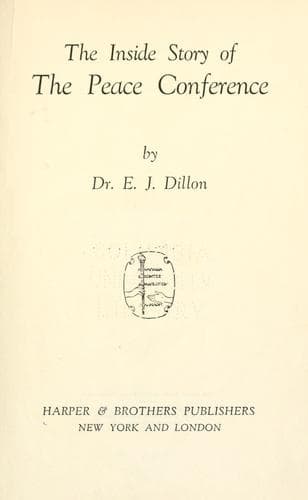
The Inside Story of the Peace ConferenceDillon, Emile Joseph
History
The Inside Story of the Peace Conference
Dillon, Emile Joseph
Paris Peace Conference (1919-1920)
On April 23d I was at the Hôtel Edouard VII, the headquarters of the
Italian delegation, discussing the outlook and expecting to learn that
some agreement had been reached. In an adjoining room the members of the
delegation were sitting in conference on the burning subject, painfully
aware that time pressed, that the Damocles's sword of Mr. Wilson's
declaration hung by a thread over their heads, and that a spirit of
large compromise was indispensable. At three o'clock Mr. Lloyd George's
secretary brought the reply of the Council of Three to Italy's maximum
of concessions. Only one point remained in dispute, I was told, but that
point hinged upon Fiume, and, by a strange chance, it was not mentioned
in the reply which the secretary had just handed in. The Italian
delegation at once telephoned to the British Premier asking him to
receive the Marquis Imperiali, who, calling shortly afterward, learned
that Fiume was to be a free city and exempt from control. It was when
the marquis had just returned that I took leave of my hosts and received
the assurance that I should be informed of the result. About half an
hour later, on receipt of an urgent message, I hastened back to the
Italian headquarters, where consternation prevailed, and I learned that
hardly had the delegates begun to discuss the contentious clause when a
copy of the _Temps_ was brought in, containing Mr. Wilson's appeal to
the Italian people "over the heads of the Italian government."
The publication fell like a powerful explosive. The public were at a
loss to fit in Mr. Wilson's unprecedented action with that of his
British and French colleagues. For if in the morning he sent his appeal
to the newspapers, it was asked, why did he allow his Italian colleagues
to go on examining a proposal on which he manifestly assumed that they
were no longer competent to treat? Moreover a rational desire to settle
Italy's Adriatic frontiers, it was observed, ought not to have lessened
his concern about the larger issues which his unwonted procedure was
bound to raise. And one of these was respect for authority, the loss of
which was the taproot of Bolshevism. Signor Orlando replied to the
appeal in a trenchant letter which was at bottom a reasoned protest
against the assumed infallibility of any individual and, in particular,
of one who had already committed several radical errors of judgment.
What the Italian Premier failed to note was the consciousness of
overwhelming power and the will to use it which imparted its specific
mark to the whole proceeding. Had he realized this element, his
subsequent tactics would perhaps have run on different lines.
Public-domain text, read in full here on John Shaqi.
Reviews
Reviews
No reviews yet
Be the first to share your thoughts on this work.
Elsewhere in the archive
Join the Discussion
Join the discussion
Sign in to leave a comment or review.
Sign InorCreate an account