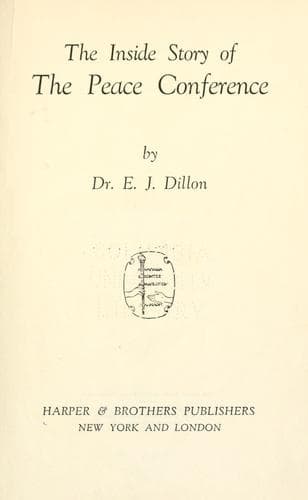
The Inside Story of the Peace ConferenceDillon, Emile Joseph
History
The Inside Story of the Peace Conference
Dillon, Emile Joseph
Paris Peace Conference (1919-1920)
But it may be maintained that the imperative nature of the task which
confronted the Conference demanded a chart of ideas and principles
different from that by which Old World diplomacy had been guided and
that respect for the letter of a compact should not be allowed to
destroy its spirit. There is much to be said for this contention, which
was, however, rejected by Italian jurists as destructive of the
sacredness of treaties. They also urged that even if it were permissible
to dash formal obstacles aside in order to clear the path for the
furtherance of a good cause, it is also indispensable that the result
should be compassed with the smallest feasible sacrifice of principle.
Hopes were accordingly entertained by the Italian delegates that, on
their return to Paris, at least a formal declaration might be made that
Italy's signature was indispensable to the validity of the Treaty. But
they were not, perhaps could not, be fulfilled at that conjuncture.
Advantage was taken in other ways of the withdrawal of Italy's
representatives from the Conference. For example, a clause of the Treaty
with Germany dealing with reparations was altered to Italy's detriment.
Another which turned upon Austro-German relations was likewise modified.
Before the delegates left for Rome it had been settled that Germany
should be bound over to respect Austria's independence. This obligation
was either superfluous, every state being obliged to respect the
independence of every other, or else it had a cryptic meaning which
would only reveal itself in the application of the clause. As soon as
the Conference was freed from the presence of the Italians the formula
was modified, and Germany was plainly forbidden to unite with Austria,
even though Austria should expressly desire amalgamation. As this
enactment runs directly counter to the principle of self-determination,
the Italian Minister Crespi raised his voice in energetic protest
against this and the financial changes,[223] whereupon the Triumvirs,
giving way on the latter point, consented to restore the primitive text
of the financial condition.[224] Germany is obliged to supply France
with seven million tons of coal every year by way of restitution for
damage done during the war. At the price of fifty francs a ton, the
money value of this tribute would be three hundred and fifty million
francs, of which Italy would be entitled to receive 30 per cent. But
during the absence of the Italian representatives a supplementary clause
was inserted in the Treaty[225] conferring a special privilege on France
which renders Italy's claim of little or no value. It provides that
Germany shall deliver annually to France an amount of coal equal to the
difference between the pre-war production of the mines of Pas de Calais
and the Nord, destroyed by the enemy, and the production of the mines of
the same area during each of the coming years, the maximum limit to be
twenty million tons. As this contribution takes precedence of all
Public-domain text, read in full here on John Shaqi.
Reviews
Reviews
No reviews yet
Be the first to share your thoughts on this work.
Elsewhere in the archive
Join the Discussion
Join the discussion
Sign in to leave a comment or review.
Sign InorCreate an account