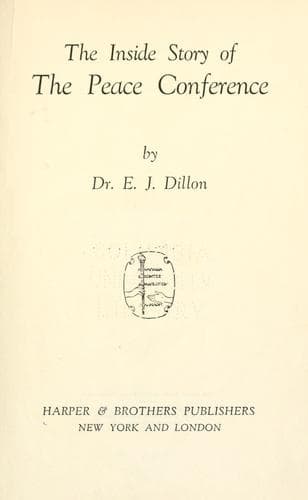
The Inside Story of the Peace ConferenceDillon, Emile Joseph
History
The Inside Story of the Peace Conference
Dillon, Emile Joseph
Paris Peace Conference (1919-1920)
Passing to more momentous matters, one may pertinently ask whether too
much stress was not laid by the first Italian delegation upon the
national and sentimental sides of Italy's interests, and too little on
the others. Among the Great Powers Italy is most in need of raw
materials. She is destitute of coal, iron, cotton, and naphtha. Most of
them are to be had in Asia Minor. They are indispensable conditions of
modern life and progress. To demand a fair share of them as guerdon for
having saved Europe, and to put in her claim at a moment when Europe was
being reconstituted, could not have been construed as imperialism. The
other Allies had possessed most of those necessaries in abundance long
before the war. They were adding to them now as the fruits of a victory
which Italy's sacrifices had made possible. Why, then, should she be
left unsatisfied? Bitterly though the nation was disappointed by failure
to have its territorial claims allowed, it became still more deeply
grieved when it came to realize that much more important advantages
might have been secured if these had been placed in the forefront of the
nation's demands. Emigration ground for Italy's surplus population,
which is rapidly increasing, coal and iron for her industries might
perhaps have been obtained if the Italian plan of campaign at the
Conference had been rightly conceived and skilfully executed. But this
realistic aspect of Italy's interests was almost wholly lost sight of
during the waging of the heated and unfruitful contests for the
possession of town and ports, which, although sacred symbols of
Italianism, could not add anything to the economic resources which will
play such a predominant part in the future struggle for material
well-being among the new and old states. There was a marked propensity
among Italy's leaders at home and in Paris to consider each of the
issues that concerned their country as though it stood alone, instead of
envisaging Italy's economic, financial, and military position after the
war as an indivisible problem and proving that it behooved the Allies in
the interests of a European peace to solve it satisfactorily, and to
provide compensation in one direction for inevitable gaps in the other.
This, to my thinking, was the fundamental error of the Italian and
Allied statesmen for which Europe may have to suffer. That Italy's
policy cannot in the near future return to the lines on which it ran
ever since the establishment of her national unity, whatever her allies
may do or say, will hardly be gainsaid. Interests are decisive factors
of foreign policy, and the action of the Great Powers has determined
Italy's orientation.
Public-domain text, read in full here on John Shaqi.
Reviews
Reviews
No reviews yet
Be the first to share your thoughts on this work.
Elsewhere in the archive
Join the Discussion
Join the discussion
Sign in to leave a comment or review.
Sign InorCreate an account