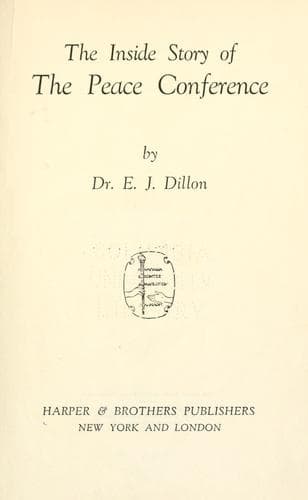
The Inside Story of the Peace ConferenceDillon, Emile Joseph
History
The Inside Story of the Peace Conference
Dillon, Emile Joseph
Paris Peace Conference (1919-1920)
Nippon's rôle in the war and the circumstances that shaped it are
scarcely realized by the general public. They have been purposely thrust
in the background. And yet a knowledge of them is essential to those who
wish to understand the significance of the dispute about Shantung, which
at bottom was the problem of Japan's international status. Before
attempting to analyze them, however, it may not be amiss to remark that
during the French press campaign conducted in the years 1915-16, with
the object of determining the Tokio Cabinet to take part in the military
operations in Europe, the question of motive was discussed with a degree
of tactlessness which it is difficult to account for. It was affirmed,
for example, that the Mikado's people would be overjoyed if the Allied
governments vouchsafed them the honor of participating in the great
civilizing crusade against the Central Empires. That was proclaimed to
be such an enviable privilege that to pay for it no sacrifice of men or
money would be exorbitant. Again, the degree to which Germany is a
menace to Japan was another of the texts on which Entente publicists
relied to scare Nippon into drastic action, as though she needed to be
told by Europeans where her vital interests lay, from what quarters they
were jeopardized, and how they might be safeguarded most successfully.
So much for the question of tact and form. Japan has never accepted the
doctrine of altruism in politics which her Western allies have so
zealously preached. Until means have been devised and adopted for
substituting moral for military force in the relations of state with
state, the only reconstruction of the world in which the Japanese can
believe is that which is based upon treaties and the pledged word. That
is the principle which underlies the general policy and the present
strivings of our Far Eastern ally.
One of the characteristic traits of all Nippon's dealings with her
neighbors is loyalty and trustworthiness. Her intercourse with Russia
before and after the Manchurian campaign offers a shining example of all
the qualities which one would postulate in a true-hearted neighbor and a
stanch and chivalrous ally. I had an opportunity of watching the
development of the relations between the two governments for many years
before they quarreled, and subsequently down to 1914, and I can state
that the praise lavished by the Tsar's Ministers on their Japanese
colleagues was well deserved. And for that reason it may be taken as an
axiom that whatever developments the present situation may bring forth,
the Empire of Nippon will carry out all its engagements with scrupulous
exactitude, in the spirit as well as the letter.
Public-domain text, read in full here on John Shaqi.
Reviews
Reviews
No reviews yet
Be the first to share your thoughts on this work.
Elsewhere in the archive
Join the Discussion
Join the discussion
Sign in to leave a comment or review.
Sign InorCreate an account