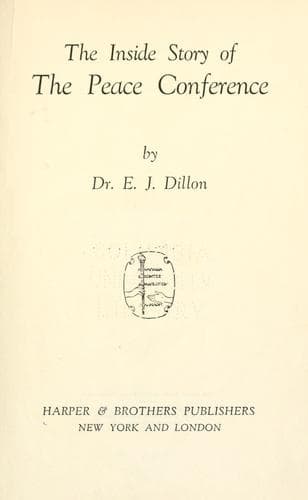
The Inside Story of the Peace ConferenceDillon, Emile Joseph
History
The Inside Story of the Peace Conference
Dillon, Emile Joseph
Paris Peace Conference (1919-1920)
"In Japan, and as yet in Japan alone, do we find the Asiatic welcoming
European culture, in which, if a tree may fairly be judged by its fruit,
is to be found the best prospect for the human personal liberty, in due
combination with restraints of law sufficient to, but not in excess of,
the requirements of the general welfare. In this particular
distinctiveness of characteristic, which has thus differentiated the
receptivity of the Japanese from that of the continental Asiatic, we may
perhaps see the influence of the insular environment that has permitted
and favored the evolution of a strong national personality; and in the
same condition we may not err in finding a promise of power to preserve
and to propagate, by example and by influence, among those akin to her,
the new policy which she has adopted, and by which she has profited,
affording to them the example which she herself has found in the
development of Eastern peoples."[245]
Now that is exactly what the Japanese aimed at accomplishing. They were
desirous of contributing to the intellectual and moral advance of the
Chinese and other backward peoples of the Far East, in the same way as
France is laudably desirous of aiding the Syrians, or Great Britain the
Persians. And what is more, Japan undertook to uphold the principle of
the open door, and generally to respect the legitimate interests of
European peoples in the Far East.
But the white races had economic designs of their own on China, and one
of the preliminary conditions of their execution was that Japan's
aspirations should be foiled. Witte opened the campaign by inaugurating
the process of peaceful penetration, but his remarkable efforts were
neutralized and defeated by his own sovereign. The Japanese, after the
Manchurian campaign, which they had done everything possible to avoid,
contrived wholly to eliminate Russian aggression from the Far East. The
feat was arduous and the masterly way in which it was tackled and
achieved sheds a luster on Japanese statesmanship as personified by
Viscount Motono. The Tsardom, in lieu of a potential enemy, was
transformed into a stanch and powerful friend and ally, on whom Nippon
could, as she believed, rely against future aggressors. Russia came to
stand toward her in the same political relationship as toward France.
Japanese statesmen took the alliance with the Tsardom as a solid and
durable postulate of their foreign policy.
Public-domain text, read in full here on John Shaqi.
Reviews
Reviews
No reviews yet
Be the first to share your thoughts on this work.
Elsewhere in the archive
Join the Discussion
Join the discussion
Sign in to leave a comment or review.
Sign InorCreate an account