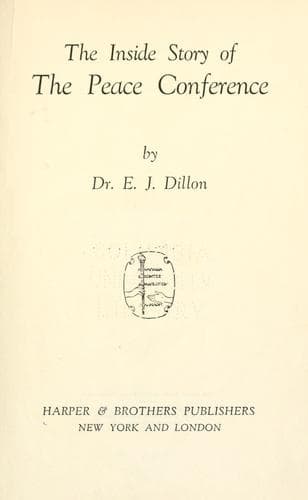
The Inside Story of the Peace ConferenceDillon, Emile Joseph
History
The Inside Story of the Peace Conference
Dillon, Emile Joseph
Paris Peace Conference (1919-1920)
If we add to all these conflicting data the circumstance that Great
Britain, France, and Russia had undertaken[256] to support Japan's
demands at the Conference, and that Italy had promised to raise no
objection, we shall have a tolerable notion of the various factors of
the Chino-Japanese dispute, and of its bearings on the Peace Treaty and
on the principles of the Covenant. It was one of the many illustrations
of the incompatibility of the Treaty and the Covenant, the respective
scopes of which were radically and irreconcilably different. The
Supreme Council had to adjudicate upon the matter from the point of view
either of the Treaty or of the Covenant; as part of a vulgar bargain of
the old, unregenerate days, or as an example of the self-renunciation of
the new ethical system. The majority of the Council was pledged to the
former way of contemplating it, and, having already promulgated a number
of decrees running counter to the Covenant doctrine in favor of their
own peoples, could not logically nor politically make an exception to
the detriment of Japan.
What actually happened at the Peace Table is still a secret, and
President Wilson, who knows its nature, holds that it is in the best
interests of humanity that it should so remain! The little that has as
yet been disclosed comes mainly from State-Secretary Lansing's answers
to the questions put by the Senate Foreign Relations Committee.
America's second delegate, in answer to the questions with which he was
there plied, affirmed that "President Wilson alone approved the Shantung
decision, that the other members of the American delegation made no
protest against it, and that President Wilson alone knows whether Japan
has guaranteed to return Shantung to China."[257] Another eminent
American, who claims to have been present when President Wilson's act
was officially explained to the Chinese delegates, states that the
President, disclosing to them his motives, pleaded that political
exigencies, the menace that Japan would abandon the Conference, and the
rumor that England herself might withdraw, had constrained him to accept
the Shantung settlement in order to save the League.[258] Rumors appear
to have played an undue part in the Conference, influencing the judgment
or the decisions of the Supreme Council. The reader will remember that
it was a rumor to the effect that the Italian government had already
published a decree annexing Fiume that is alleged to have precipitated
the quarrel between Mr. Wilson and the first Italian delegation. It is
worth noting that the alleged menace that Japan would quit the
Conference if her demands were rejected was not regarded by Secretary
Lansing as serious. "Could Japan's signature to the League have been
obtained without the Shantung decision?" he was asked. "I think so," he
answered.
Public-domain text, read in full here on John Shaqi.
Reviews
Reviews
No reviews yet
Be the first to share your thoughts on this work.
Elsewhere in the archive
Join the Discussion
Join the discussion
Sign in to leave a comment or review.
Sign InorCreate an account