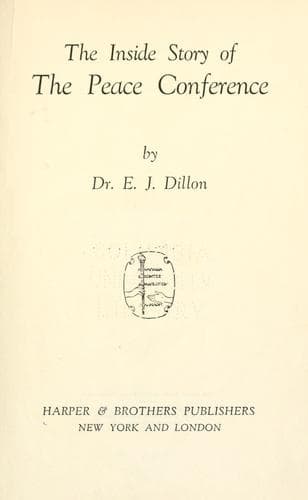
The Inside Story of the Peace ConferenceDillon, Emile Joseph
History
The Inside Story of the Peace Conference
Dillon, Emile Joseph
Paris Peace Conference (1919-1920)
President Wilson and Mr. Lloyd George had inaugurated their East
European policy by publicly proclaiming that Russia was the key to the
world situation, and that the peace would be no peace so long as her
hundred and fifty million inhabitants were left floundering in chaotic
confusion, under the upas shade of Bolshevism. They had also held out
hopes to their great ex-ally of efficient help and practical counsel.
And there ended what may be termed the constructive side of their
conceptions.
It was followed by no coherent action. Discourses, promises, maneuvers,
and counter-maneuvers were continuous and bewildering, but of systematic
policy there was none. Statesmanship in the higher sense of the word was
absent from every decision the delegates took and from every suggestion
they proffered. Nor was it only by omission that they sinned. Their
invincible turn for circuitous methods, to which severer critics give a
less sonorous name, was manifested _ad nauseam_. They worked out cunning
little schemes which it was hard to distinguish from intrigues, and
which, if they had not been foiled in time, would have made matters even
worse than they are. From the outset the British government was for
summoning Bolshevist delegates to the Conference. A note to this effect
was sent by the London Foreign Office to the Allied governments about a
fortnight before the delegates began their work of making peace. But
the suggestion was withdrawn at the instance of the French, who doubted
whether the services of systematic lawbreakers would materially conduce
to the establishment of a new society of law-abiding states. Soon
afterward another scheme cropped up, this time for the appointment of an
Inter-Allied committee to watch over Russia's destinies and serve as a
sort of board of Providence. The representatives of the anti-Bolshevist
governments resented this notion bitterly. They remarked that they could
not be fairly asked to respect decisions imposed on them exactly as
though they were vanquished enemies like the Germans. The British and
American delegates were swayed in their views mainly by the assumptions
that all central Russia was in the power of Lenin; that his army was
well disciplined and powerful; that he might contrive to hold the reins
of government and maintain anarchism indefinitely, and that the
so-called constructive elements were inclined toward reaction.
Public-domain text, read in full here on John Shaqi.
Reviews
Reviews
No reviews yet
Be the first to share your thoughts on this work.
Elsewhere in the archive
Join the Discussion
Join the discussion
Sign in to leave a comment or review.
Sign InorCreate an account