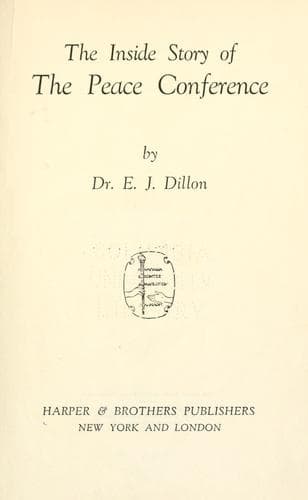
The Inside Story of the Peace ConferenceDillon, Emile Joseph
History
The Inside Story of the Peace Conference
Dillon, Emile Joseph
Paris Peace Conference (1919-1920)
The Prinkipo incident, which began in the region of high politics, ended
in comedy. A number of more or less witty epigrams were coined at the
expense of the plenipotentiaries, the scheme, set in a stronger light
than it was meant to endure, assumed a grotesque shape, and its
promoters strove to consign it as best they could to oblivion. But the
Sphinx question of Russia's future remained, and the penalties for
failure to solve it aright waxed more and more deterrent. The supreme
arbiters had cognizance of them, had, in fact, enumerated them when
proclaiming the impossibility of establishing a durable peace or a solid
League of Nations as long as Russia continued to be a prey to anarchy.
But even with the prizes and penalties before their eyes to entice and
spur them, they proved unequal to the task of devising an intelligent
policy. Fitful and incoherent, their efforts were either incapable of
being realized or, when feasible, were mischievous. Thus, by degrees,
they hardened the great Slav nation against the Entente.
The reader will be prepared to learn that the overtures made to the
Bolsheviki kindled the anger of the patriotic Russians at home, who had
been looking to the Western nations for salvation and making veritable
holocausts in order to merit it. Every observer could perceive the
repercussion of this sentiment in Paris, and I received ample proofs of
it from Siberia. There the leaders and the population unhesitatingly
turned for assistance to Japan. For this there were excellent reasons.
The only government which throughout the war knew its own mind and
pursued a consistent and an intelligible policy toward Russia was that
of Tokio. This point is worth making at a time when Japan is regarded as
a Laodicean convert to the invigorating ideas of the Western peoples, at
heart a backslider and a potential schismatic. She is charged with
making interest the mainspring of her action in her intercourse with
other nations. The charge is true. Only a Candide would expect to see
her moved by altruism and self-denial, in a company which penalizes
these virtues. Community of interests is the link that binds Japan to
Britain. A like bond had subsisted between her and Tsarist Russia. I
helped to create it. Her statesmen, who have no taste for sonorous
phraseology, did not think it necessary to give it a more fashionable
name. This did not prevent the Japanese from being chivalrously loyal to
their allies under the strain of powerful temptations, true to the
spirit and the letter of their engagements. But although they made no
pretense to lofty purpose, their political maxims differ nowise from
those of the great European states, whose territorial, economic, and
military interests have been religiously safeguarded by the Treaty of
Versailles. True, the statesmen of Tokio shrink from the hybrid
combination of two contradictions linked together by a sentimental
fallacy. Their unpopularity among Anglo-Saxons is the result of
Public-domain text, read in full here on John Shaqi.
Reviews
Reviews
No reviews yet
Be the first to share your thoughts on this work.
Elsewhere in the archive
Join the Discussion
Join the discussion
Sign in to leave a comment or review.
Sign InorCreate an account