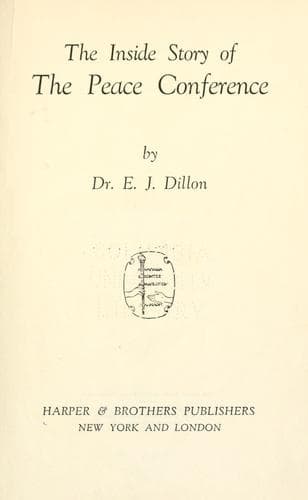
The Inside Story of the Peace ConferenceDillon, Emile Joseph
History
The Inside Story of the Peace Conference
Dillon, Emile Joseph
Paris Peace Conference (1919-1920)
In Russia there are millions of Germans conversant with the language,
laws, and customs of the people. Many of them have been settled there
for generations. They are passionately attached to their race, and
neither unfriendly nor useless to the country of their adoption. The
trade, commerce, and industry of the European provinces are largely in
their hands and in those of their forerunners and helpers, the Jews. The
Russo-German and Jewish middlemen in the country have their faces ever
turned toward the Fatherland. They are wont to buy and sell there. They
always obtained their credit in Berlin, Dresden, or Frankfurt. They
acted as commercial travelers, agents, brokers, bankers, for Russians
and Germans. They are constantly going and coming between the two
countries. How are these myriads to be fettered permanently and kept
from eking out a livelihood in the future on the lines traced by
necessity or interest in the past? The Russians, on their side, must
live, and therefore buy and sell. Has the Conference or the League the
right or power to dictate to them the persons or the people with whom
alone they may have dealings? Can it narrow the field of Russia's
political activities? Some people flatter themselves that it can. In
this case the League of Nations must transform itself into an alliance
for the suppression of the German race.
Burning indignation and moral reprobation were the sentiments aroused
among the high-minded Allies by the infamous Treaty of Brest-Litovsk.
For that mockery of a peace, even coming from an enemy, transcended the
bounds of human vengeance. It was justly anathematized by all Entente
peoples as the loathsome creation of a frenzied people. But shortly
afterward the Entente governments themselves, their turn having come,
wrought what Russians of all parties regard as a political patchwork of
variegated injustice more odious far, because its authors claimed to be
considered as the devoted friends of their victims and the champions of
right. Whereas the Brest-Litovsk Treaty provided for a federative Slav
state, with provincial diets and a federal parliament, the system
substituted by the Allies consisted in carving up Russia into an
ever-increasing number of separate states, some of which cannot live by
themselves, in debarring the inhabitants from a voice in the matter, in
creating a permanent agency for foreign intervention, and ignoring
Russia's right to reparation from the common enemy. The Russians were
not asked even informally to say what they thought or felt about what
was being done. This province and that were successively lopped off in a
lordly way by statesmen who aimed at being classed as impartial
dispensers of justice and sowers of the seeds of peace, but were
unacquainted with the conditions and eschewed investigation. Here, at
all events, the usual symptoms of hesitancy and procrastination were
absent. Swift resolve and thoroughness marked the disintegrating action
Public-domain text, read in full here on John Shaqi.
Reviews
Reviews
No reviews yet
Be the first to share your thoughts on this work.
Elsewhere in the archive
Join the Discussion
Join the discussion
Sign in to leave a comment or review.
Sign InorCreate an account