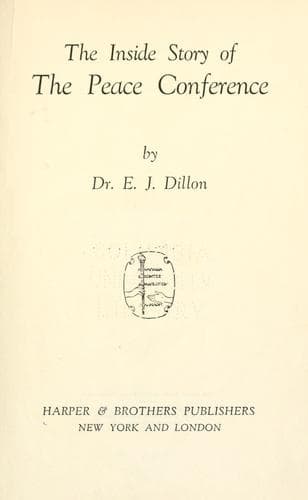
The Inside Story of the Peace ConferenceDillon, Emile Joseph
History
The Inside Story of the Peace Conference
Dillon, Emile Joseph
Paris Peace Conference (1919-1920)
"Bolshevism" connoted the revolutionary wave that swept over some of the
Slav and German lands. But only for a moment. One may safely assert, as
a general proposition, that the same undertaking, if the Germans and the
Russians set their hands to it, becomes forthwith two separate
enterprises, so different are the conceptions and methods of these two
peoples. Bolshevism was almost emptied of its contents by the Germans,
and little left of it but the empty shell.
Comparisons between the orgasms of collective madness which accompanied
the Russian welter, on the one hand, and the French Revolution, on the
other, are unfruitful and often misleading. It is true that at the
outset those spasms of delirium were in both cases violent reactions
against abuses grown well-nigh unbearable. It is also a fact that the
revolutionists derived their preterhuman force from historic events
which had either denuded those abuses of their secular protection or
inspired their victims with wonder-working faith in their power to sweep
them away. But after this initial stage the likeness vanishes. The
French Revolution, which extinguished feudalism as a system and the
nobility as a privileged class, speedily ceased to be a mere dissolvent.
In its latter phases it assumed a constructive character. Incidentally
it created much that was helpful in substance if not beautiful in form,
and from the beginning it adopted a positive doctrine as old as
Christianity, but new in its application to the political sphere. Thus,
although it uprooted quantities of wheat together with the tares, its
general effect was to prepare the ground for a new harvest. It had a
distinctly social purpose, which it partially realized. Nor should it
be forgotten that in the psychological sphere it kindled a transient
outburst of quasi-religious enthusiasm among its partizans, imbued them
with apostolic zeal, inspired them with a marvelous spirit of
self-abnegation, and nerved their arms to far-resonant exploits. And the
forces which the revolution thus set free changed many of the forms of
the European world, but without reshaping it after the image of the
ideal.
Has the withering blight known as Bolshevism any such redeeming traits
to its credit account? The consensus of opinion down to the present
moment gives an emphatic, if summary, answer in the negative. Every
region over which it swept is blocked with heaps of unsightly ruins, It
has depreciated all moral values. It passed like a tornado, spending its
energies in demolition. Of construction hardly a trace has been
discerned, even by indulgent explorers.[275] One might liken it to a
so-called possession by the spirit of evil, wont of yore to use the
human organs as his own for words of folly and deeds of iniquity.
Bolshevism has operated uniformly as a quick solvent of the social
organism. Doubtless European society in 1917 sorely needed purging by
drastic means, but only a fanatic would say that it deserved
annihilation.
Public-domain text, read in full here on John Shaqi.
Reviews
Reviews
No reviews yet
Be the first to share your thoughts on this work.
Elsewhere in the archive
Join the Discussion
Join the discussion
Sign in to leave a comment or review.
Sign InorCreate an account