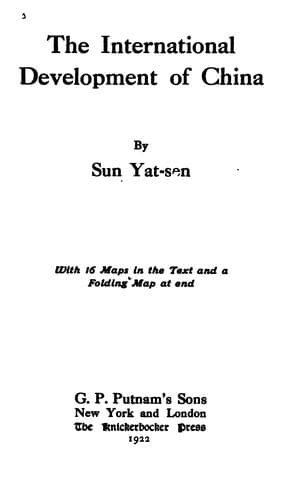
The International Development of ChinaSun, Yat-sen
History
The International Development of China
Sun, Yat-sen
China -- Economic conditions -- 1912-1949; Railroads -- China
This line starts from Iden, and proceeds southward along the Keriya
River to Polu, thence following the caravan road up the highland to
Kuluk. From Kuluk, it proceeds southwestward via Alasa and Tunglong
to Nohho, where it meets the terminus of the Lhasa-Nohho line. After
Nohho, it skirts around the eastern end of the Noh-tso-Lake to Rudok
and proceeds southwestward to Demchok, on the Indus River. From
Demchok, it proceeds southeastward following the Indus River up to
Gartok, where it ends by joining the Lhasa-Laichiyaling line. This line
covers a distance of about 500 miles. This highland system totals about
11,000 miles.
PART VI
The Establishment of Locomotive and Car Factories
The railways projected in the Fourth Program will total about 62,000
miles; and those in the First and the Third Programs about 14,000
miles. Besides these, there will be double tracks in the various trunk
lines, which will make up a grand total of no less than 100,000 miles,
as stated in the preliminary part of these programs. With this 100,000
miles of railways to be constructed in the coming ten years, the
demands for locomotives and cars will be tremendous. The factories of
the world will be unable to supply them, especially at this juncture
of reconstruction after the great world war. So the establishment
of locomotive and car factories in China to supply our own demands
of railway equipment will be a necessary as well as a profitable
undertaking. China possesses unlimited supplies of raw materials and
cheap labor. What we need for establishing such factories is foreign
capital and experts. What amount of capital should be invested in this
project, I have to leave to experts to decide.
I suggest that four large factories should be started simultaneously at
the beginning--two on the coast and two on the Yangtze. Of those on the
coast, one should be at the Great Northern Port, and the other at the
Great Southern Port--Canton. Of those on the Yangtze, one should be at
Nanking and the other at Hankow. All four are in centers of both land
and water communication, where skilled labor can easily be obtained.
They are also near our iron and coal fields. Besides these four great
factories, others should be established at suitable centers of iron and
coal fields when our railways will be more developed.
All the factories should be under one central control. The locomotives
and cars of our future railways should be standardized so as to make
possible the interchange of parts of machinery and equipment. We should
also adopt the standard gauge, that is, the 4 feet 8½ inch gauge which
has been adopted by most of the railways of the world. In fact, almost
all the railways hitherto built in China are of this gauge. The purpose
of the proposed standardization is to secure the highest efficiency as
well as the greatest economy.
PROGRAM V
Public-domain text, read in full here on John Shaqi.
Reviews
Reviews
No reviews yet
Be the first to share your thoughts on this work.
Elsewhere in the archive
Join the Discussion
Join the discussion
Sign in to leave a comment or review.
Sign InorCreate an account