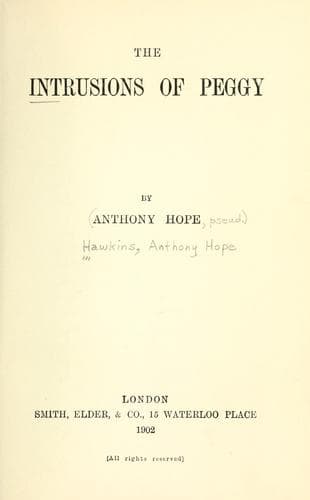
Female friendship -- Fiction; London (England) -- Social life and customs -- Fiction; Widows -- Fiction
'So do I,' nodded Lady Blixworth heartily.
Barmouth passed rapidly from the dangers of such criticism.
'It is probably essential in the interests of society,' he added, with a
return of dignity.
'Oh, probably,' she conceded, with a carelessness appropriate to the
subject. 'Do you think there's another man?'
'I beg your pardon, Viola?' He was obviously astonished, and inclined to
be offended.
'Any man she liked or had liked, you know?'
'She was engaged to my son.'
That certainly sounded final, but Lady Blixworth was not abashed.
'An engagement is just what brings the idea of the other man back
sometimes,' she observed.
'We have no reason to suspect it in this case. I will not suspect it
without definite grounds. In spite of everything let us be just.'
Lady Blixworth agreed to be just, with a rather weary air. 'Do give my
best love to dear Lady Barmouth, and do send Mortimer to see me,' she
implored her distressed visitor, when he took his leave.
The coast was clear. If she knew anything of the heart of man--as she
conceived she did--the juncture of affairs was not unfavourable;
ill-used lovers may sometimes be induced to seek softer distractions
than Trans-Euphratic or other railways. She telegraphed to Audrey
Pollington to cut short a visit which she was paying in the country. At
any rate Audrey would not have ruined herself nor run away. In a spirit
not over-complimentary either to Audrey or to Barslett, Lady Blixworth
decided that they would just suit one another.
'The marriage arranged, &c., will not take place.' When a lady
disappears by night, and sends no communication save a telegram, giving
no address and asking that her luggage may be consigned to Charing Cross
station, 'to be called for,' it is surely justifiable to insert that
curt intimation of happiness frustrated or ruin escaped; the doubt in
which light to look at it must be excused, since it represents
faithfully the state of Mervyn's mind. He still remembered Trix as he
had thought her, still had visions of her as what he had meant her to
become; with the actual Trix of fact he was naturally in a fury of
outraged self-esteem.
'I would have forgiven her,' he told Mrs. Bonfill, not realising at all
that this ceremony, or process, was the very thing which Trix had been
unable to face. 'In a little while we might have forgotten it, if she
had shown proper feeling.'
'She's the greatest disappointment I ever had in my life,' declared Mrs.
Bonfill. 'Not excepting even Beaufort Chance! I needn't say that I wash
my hands of her, Mortimer.' Mrs. Bonfill was very sore; people would
take advantage of Trix's escapade to question the social infallibility
of her sponsor.
'We have no alternative,' he agreed gloomily.
'You mustn't think any more about her; you have your career.'
'I hate the gossip,' he broke out fretfully.
'If you say nothing, it will die away. For the moment it is
unavoidable--you are so conspicuous.'
Public-domain text, read in full here on John Shaqi.
Reviews
Reviews
No reviews yet
Be the first to share your thoughts on this work.
Elsewhere in the archive
Join the Discussion
Join the discussion
Sign in to leave a comment or review.
Sign InorCreate an account